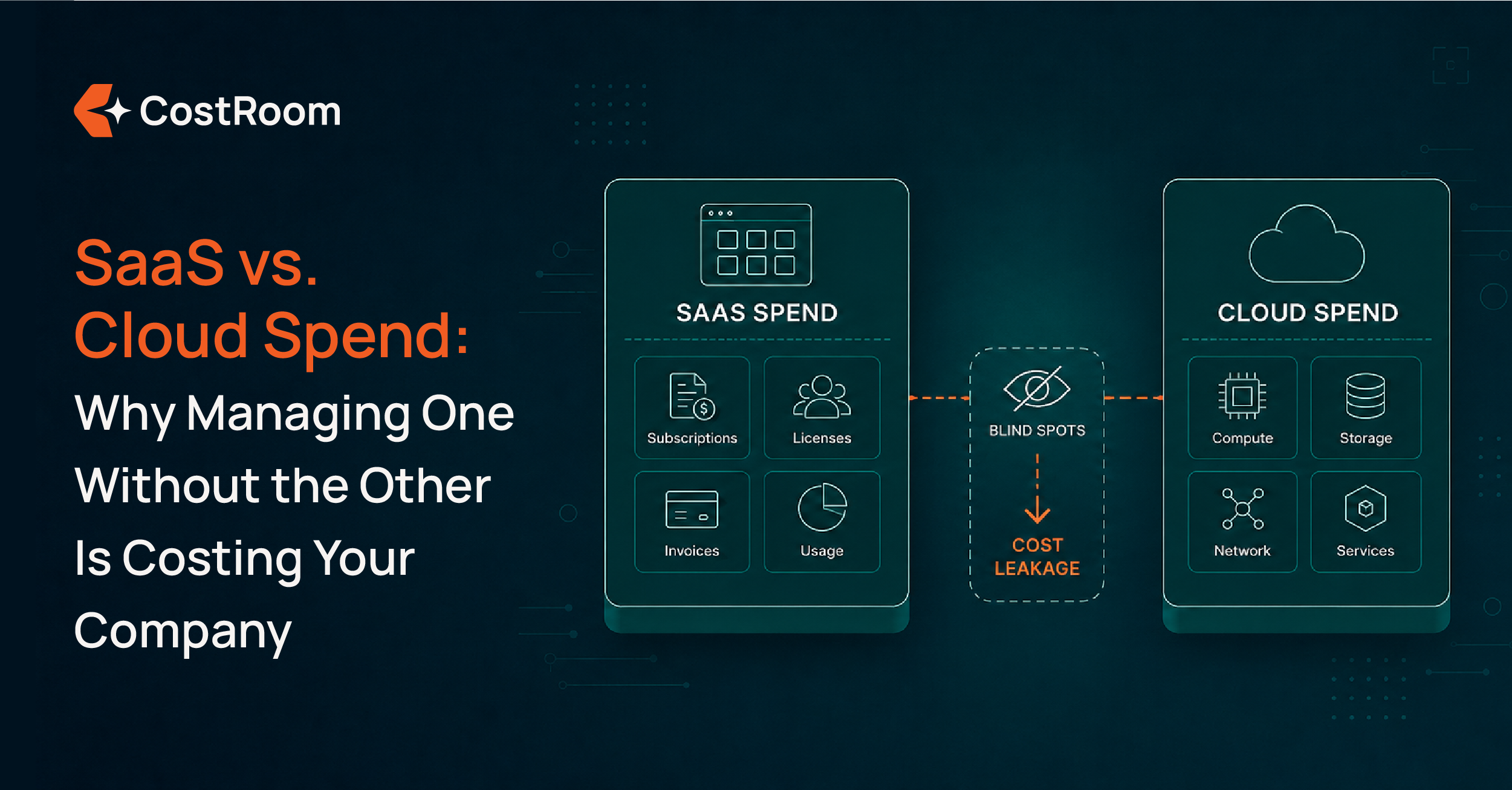
Most mid-size companies have someone who manages the SaaS invoices. They also have someone who monitors the cloud bill. These are usually different people, working from different dashboards, reporting to different parts of the business.
The logic behind this arrangement is understandable. SaaS looks like a finance and IT coordination problem: subscriptions, invoices, licence counts. Cloud looks like an infrastructure problem: compute, storage, network, managed by engineering. Keep the owners separate and the problems stay contained.
The logic is wrong. The cost of that assumption shows up in ways that are genuinely difficult to trace back to the source, which is part of why it persists for so long before anyone addresses it.
How the Split Happens in the First Place
SaaS adoption at mid-size companies is typically bottom-up. Teams identify tools they need, make the case internally, get approved, and the subscription appears on the company's invoices. Sales picks a CRM. Marketing picks an analytics platform. HR picks a performance management tool. Finance picks a spend tracking tool, sometimes without realising it is now one of over a hundred similar entries on the company's master invoice list.
Each purchase is approved individually. The collective picture rarely gets assembled in one place.
Cloud spending works differently. AWS, Azure, or GCP infrastructure tends to originate from engineering decisions: which services to run, how much compute to provision, which regions to deploy in. The cloud bill arrives as a single consolidated invoice that only the engineering team fully understands, while finance sees the total and has limited ability to interrogate it.
This separation made intuitive sense when SaaS was a handful of tools and cloud was purely an engineering concern. At a company with 200–500 employees running well over a hundred SaaS subscriptions and a multi-cloud infrastructure, the intuition no longer holds. Two of the largest controllable cost lines in the business are being managed in silos, with different owners, different tools, and no shared view.
What Falls Through the Gap
The gaps that form when SaaS and cloud spend are managed independently are specific and financially significant.
On the SaaS side, cloud costs go unexamined. Several major SaaS vendors also sell cloud infrastructure services, or their products generate cloud costs as a byproduct of how they operate. A company might hold separate contracts with the same vendor at the SaaS and infrastructure levels (contracts that could be consolidated for better pricing) without anyone ever connecting the two.
On the cloud side, SaaS-driven costs are invisible. Data storage and processing charges frequently grow because of SaaS applications that have not been configured efficiently or whose usage has expanded beyond original projections. Identifying the source of cloud cost growth requires looking at SaaS usage data simultaneously. With separate teams managing each, that analysis rarely happens.
Renewal timing gets missed on both sides. SaaS contracts and cloud commitments (reserved instances, committed use discounts) operate on different renewal cycles and live in different systems. Managing them independently means they are almost never optimised in concert. A cloud commitment that expires the month after a SaaS renewal could have been negotiated together; managed separately, both get renewed individually at suboptimal terms.
The most common gap: uncontracted spend. In a typical mid-size company, often around a third of the SaaS stack exists outside the formal procurement process: purchased directly by team members using corporate cards, added during a free trial that converted automatically, or simply never properly documented. This uncontracted spend is invisible to both the SaaS management view and the cloud cost view, because it never surfaces in either system.
The Spending Reality at Mid-Size Companies
Both SaaS and cloud infrastructure have grown into material cost lines for mid-size companies. Put them together and the company's total technology spend is almost certainly one of the three largest budget lines in the business.
The question that rarely gets asked is who owns the complete picture of that spend.
In most mid-size companies, no one does. Finance sees SaaS invoices as they arrive. Engineering manages the cloud bill. IT tracks some tools in some systems. The full number, total technology spend broken down vendor by vendor, contract by contract, and renewal date by renewal date, does not exist in any single place.
For a CFO, this is not just an efficiency problem. A technology budget that cannot be explained or defended in detail is a governance risk. It is the kind of gap that surfaces at the worst possible moment: during a board review, an audit, or a period of cost pressure when leadership needs to understand quickly which technology commitments can and cannot be moved.
Why Adding Another Tool Usually Makes It Worse
The instinct when a management gap is identified is to add a tool. The spend management tool market offers plenty of candidates, and many of them are genuinely useful within their lane. The problem is that they tend to reinforce the existing silos rather than bridge them.
SaaS management platforms provide licence-level visibility: which tools exist, who is using them, how often. They are valuable for IT teams trying to understand application utilisation. They do not negotiate contracts, they do not touch cloud infrastructure, and they do not produce the financial synthesis a CFO needs.
Cloud cost management tools do the equivalent job on the infrastructure side, tracking resource utilisation and identifying waste. They are built for engineering teams. They do not see SaaS contracts or renewal dates.
Procurement systems provide governance: structured approval workflows, purchase order management, audit trails. They are process tools. They manage how money gets spent, not whether it is being spent wisely.
Each of the three tool categories solves part of the problem and leaves the rest unaddressed. The gaps between them are where the financial opportunity sits. For a full breakdown of what a unified approach looks like, see the Complete Guide to SaaS and Cloud Spend Optimization.
What a Unified View Actually Changes
Managing SaaS and cloud spend together, in one view, with one set of owners and one optimization framework, changes three things in practice.
Total spend visibility. The company can, for the first time, see its complete technology cost as a managed portfolio rather than a collection of invoices. That portfolio view reveals vendor relationships that span SaaS and cloud services, tools that duplicate each other across different budget lines, and the complete renewal calendar for the year ahead. CostRoom's Spend Analysis and Optimization platform is built specifically to produce this view.
Negotiation leverage. Vendors who supply services at both the SaaS and infrastructure levels can be approached with full knowledge of the company's total relationship with them. A vendor who knows you have one contract will negotiate differently than a vendor who knows you have five. CostRoom's SaaS and Cloud Vendor Negotiations service operates with full portfolio visibility for exactly this reason.
Proactive renewal management. When SaaS and cloud renewal dates are mapped together, it becomes possible to build a 12-month renewal calendar and approach each vendor with adequate lead time. The difference in commercial outcomes between a renewal initiated 90 days early with market data in hand and one caught at the last moment is substantial, and it compounds across the dozens of renewals a typical mid-size company faces every quarter.
The shift from reactive to proactive is, in the end, what a unified view of SaaS and cloud spend produces. The money does not change. The visibility into where it goes, and the control over what happens to it, changes entirely. For a deeper look at what this means structurally, see What Is a Spend Optimization Layer?
The Practical Starting Point
Getting to a unified view of SaaS and cloud spend does not require implementing a new category of software before anyone has mapped the current state. The right starting point is understanding what the company is actually paying, across both SaaS and cloud, including the portion that exists outside any formal procurement system.
A spend analysis does this work: mapping contracts, licences, cloud commitments, and uncontracted spend into a single picture, then identifying where the optimization opportunities lie. For most mid-size companies, this exercise produces two results. A clear view of the current state. And a list of specific opportunities that were invisible before anyone looked at SaaS and cloud together.
Frequently Asked Questions
Why should companies manage SaaS and cloud spend together? SaaS and cloud are typically the two largest controllable technology cost lines at a mid-size company. Managing them separately creates blind spots: SaaS management tools do not see cloud infrastructure costs, cloud cost tools do not see SaaS contracts or renewal dates, and vendors who supply both SaaS and cloud services are never approached with full negotiating leverage. A unified view is the only way to optimize the total spend.
What is uncontracted spend? Uncontracted spend refers to SaaS tools or services purchased outside the formal procurement process: bought on a corporate card during a free trial, added by a team member without going through procurement, or simply never properly documented after an initial purchase. At a typical mid-size company, uncontracted spend accounts for roughly a third of the SaaS stack and is invisible to both finance and IT in any structured system.
What is the risk of managing SaaS and cloud spend in separate systems? The primary risks are missed renewals (SaaS and cloud commitments operate on different cycles and are rarely coordinated), pricing blind spots (vendors who supply both SaaS and cloud services are never negotiated with full portfolio leverage), and undetected cost growth (cloud costs driven by expanding SaaS usage are invisible when the two are managed separately).
What is the difference between a SaaS management platform and spend optimization? A SaaS management platform tracks licence-level usage: which tools exist, who is using them, and how often. It provides visibility into the SaaS stack. Spend optimization uses that visibility as an input and goes further: negotiating pricing, managing renewals, eliminating cloud waste, and addressing vendor risk. Visibility is the starting point; optimization is the outcome.
Who typically owns SaaS and cloud spend at a mid-size company, and why is that a problem? At most mid-size companies, SaaS invoices are managed by finance or IT while cloud infrastructure is managed by engineering. These teams rarely share data or review cycles. The result is that no single function owns the complete picture of total technology spend, and the gaps between them are where the largest controllable costs sit.
Related reading: