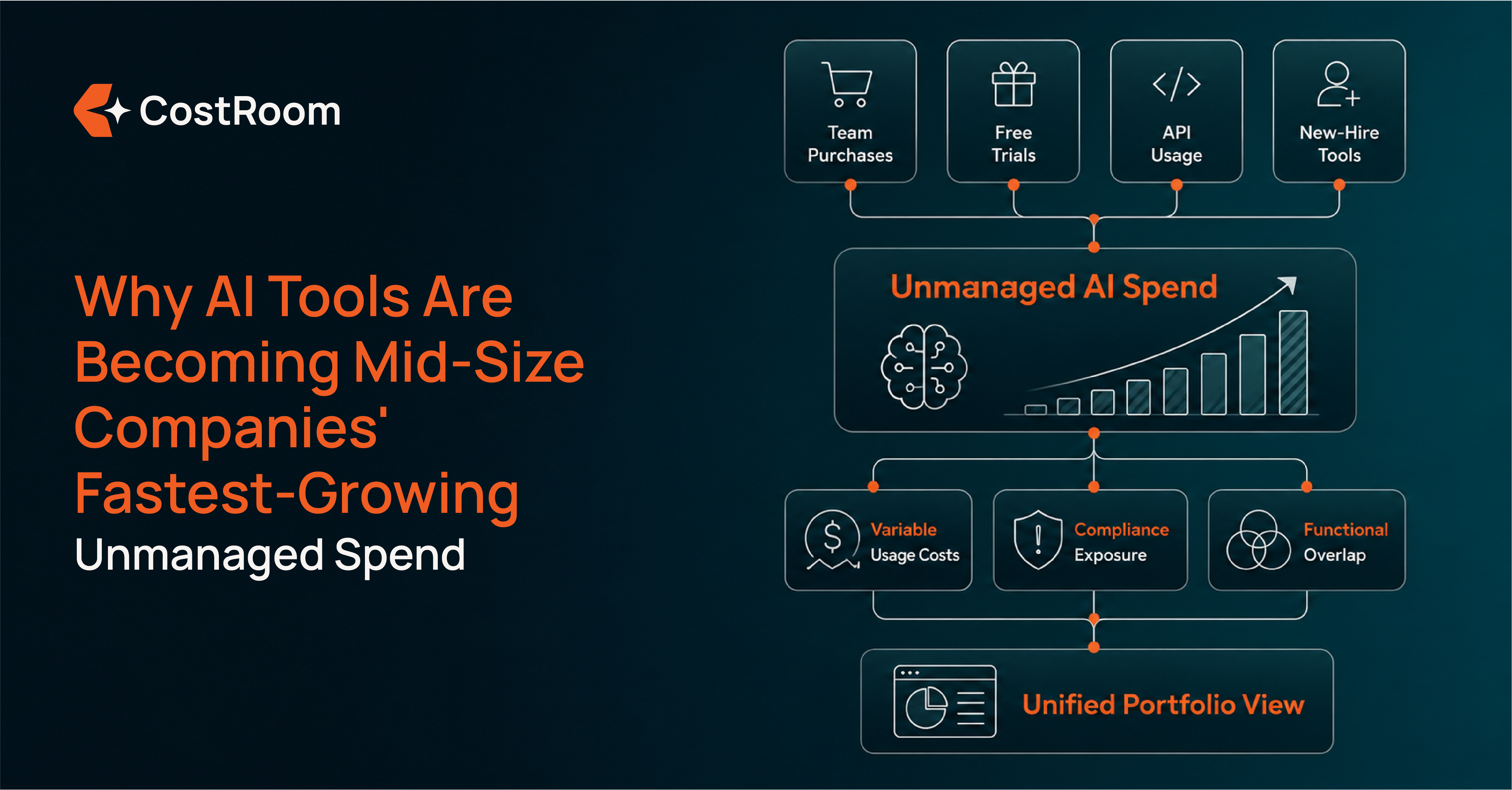
AI tools are entering company budgets through the same pathways SaaS did five years ago: team purchases below the procurement approval threshold, free trials converting to paid subscriptions without a formal step, tools carried in by new hires from their previous company, and rapid adoption during growth phases when procurement processes simply cannot keep up with the pace.
The result is the same pattern, with one difference: it is happening faster. Mid-size companies that spent years building SaaS spend visibility now have a third category accumulating in parallel, at list price, with auto-renewals nobody is tracking. The category is AI tools, and the spend gap it creates compounds every quarter it goes unmanaged.
For the full picture of how AI, SaaS, and cloud spend interact at a portfolio level, see Managing AI, SaaS, and Cloud Spend Together: A Guide for Mid-Size Companies.
The Three Ways AI Spend Differs from SaaS Spend
AI tools are not simply SaaS tools with a different label. Three structural differences make them harder to manage than SaaS spend at the equivalent stage of adoption.
Pricing models are more variable. Most SaaS tools charge a fixed monthly or annual fee per seat. The cost is predictable: if you have 50 seats, you pay for 50 seats, and the number moves only when you add or remove licences. AI tools frequently do not work this way. API-based models charge by token or by usage volume. A model API key handed to an engineering team can be used at moderate cost for weeks, then double its monthly spend when a new project drives higher volume, with no contract change, no renewal event, and no notification to finance. The cost moves without any of the signals that SaaS costs move with.
Data handling considerations are more acute. An unreviewed SaaS tool carries financial exposure: spend the company is paying for that it has not approved or negotiated. An unreviewed AI tool often carries that exposure plus a compliance exposure, because AI tools frequently process more sensitive data than equivalent SaaS tools. Customer data, internal communications, financial records: the data handling implications of an unreviewed AI subscription are not the same as those of an unreviewed project management tool. That distinction matters to the CISO and, increasingly, to the CFO.
Functional overlap is harder to detect. Two SaaS tools doing similar things are usually identifiable from their category names: two project management platforms, two CRM tools, two marketing automation systems. Two AI tools performing similar functions can look entirely different at the surface, each serving the team that adopted it as a genuinely distinct tool. Without a structured portfolio view, consolidation decisions in AI spend are harder to make than in SaaS, even when the duplication is real and significant.
Why Procurement Does Not Catch AI Spend Either
The structural reasons procurement misses SaaS spend are well-documented: purchase approval thresholds allow team-level tool adoption below the procurement review line, trial conversions happen without a formal procurement step, and subscription invoices arrive as operational expenses rather than capital commitments.
All of those structural gaps apply to AI tools in exactly the same way. AI subscriptions enter the budget at team level, below thresholds, often coded as operational costs, and renew automatically at the end of each billing period. For the parallel SaaS pattern, and what that accumulation looks like across a mid-size company portfolio, see How Uncontracted SaaS Spend Accumulates at Mid-Size Companies.
AI adoption adds one factor on top: the speed of the journey from free tier to enterprise contract. A team can move from a free ChatGPT plan to an enterprise AI subscription within weeks, sometimes without any individual purchase that triggers a threshold alert. The enterprise subscription then auto-renews annually. By the time finance notices the invoice, the tool has been embedded in the team's workflow for a year and exiting it has its own cost.
The gap between when AI tool costs begin and when they appear in any structured view of company spend is typically several months. By that point, the list price is locked in, the renewal has usually already occurred once, and the compliance review that should have happened at adoption is overdue.
What the Total Cost Looks Like
The direct cost is straightforward: AI subscriptions at list price, often negotiated at no point in their life, auto-renewing each year without review. For tools where pricing is variable rather than fixed, the cost may have already grown materially from the original subscription level.
The indirect costs compound that figure in three ways.
First, overlap. When multiple teams independently adopt AI tools for similar purposes, the company pays for both. One team's choice rarely maps to another's, and without a portfolio view nobody is in a position to assess whether consolidation is viable, or what it would save. This is not unique to AI, but the functional opacity of AI tools makes the duplication harder to surface.
Second, compliance exposure. An unreviewed AI tool that has been processing customer data for twelve months carries a compliance gap that grows with time. Closing that gap retroactively costs more than reviewing the tool at adoption would have: data audits, remediation work, potential regulatory exposure depending on the market and data category.
Third, reactive discovery costs. Unmanaged AI spend typically surfaces during finance reconciliations or CISO access reviews, both of which are expensive processes to run and both of which create urgent remediation timelines that could have been avoided with proactive management.
The total cost of unmanaged AI spend in a mid-size company is the sum of all three: list price subscriptions, duplicate tool costs, and the cost of discovering and remediating gaps reactively.
What Managing AI Spend Properly Requires
Managing AI spend properly requires bringing it into the same visibility and process discipline that SaaS and cloud spend already have, or should have. Not a separate process. The same one.
That means a complete inventory of every active AI tool, subscription, and API commitment in the company, with current cost, contract status, data handling scope, and renewal date. It means renewal tracking that covers AI subscriptions alongside SaaS and cloud commitments, so that no tool auto-renews without review. It means vendor risk assessment that includes the compliance dimension that AI tools carry. And it means sourcing new AI tools at structured rates rather than at list price, using market benchmarks and established vendor relationships rather than accepting the vendor's preferred starting point.
For what that process looks like across the full lifecycle of a vendor relationship, see What Is Full-Lifecycle Spend Optimization and Why Usage-Level Management Is Not Enough. For how vendor sourcing network relationships change entry pricing across AI, SaaS, and cloud, see How a Vendor Sourcing Network Gives Mid-Size Companies Buying Power They Don't Have Alone.
The companies managing AI tool costs well right now are not running a new or different process. They have extended the spend visibility and optimization discipline they built for SaaS to cover AI as a third category in the same portfolio.
Find Out What Your AI Spend Actually Costs
CostRoom's spend analysis maps AI, SaaS, and cloud spend together in one view.
Frequently Asked Questions
How do AI tool costs enter a company's budget without going through procurement? AI subscriptions typically enter through the same gaps that allowed SaaS to accumulate unmanaged: team-level purchases below the approval threshold, free trials that convert to paid plans without a formal review step, and tools brought in by new hires from their previous company. The speed of AI adoption from free to enterprise contract is often faster than the equivalent SaaS journey, which means the gap between adoption and any procurement awareness is shorter in calendar time but larger in cost by the time it closes.
Why are AI tool costs harder to track than SaaS costs? Three factors: pricing models are more variable (token and API-based pricing can increase without any contract change), data handling considerations are more acute (unreviewed AI tools carry compliance exposure that unreviewed SaaS tools typically do not), and functional overlap between AI tools is harder to detect (two tools doing similar things may look nothing alike at the category level). These factors combine to make AI spend less visible than equivalent SaaS spend at the same stage of portfolio accumulation.
What is the compliance risk of unreviewed AI tools? AI tools often process sensitive business data: customer records, internal communications, financial information. When an AI tool enters a company's stack without a formal review, the data handling implications go unexamined. In regulated industries and markets with data protection requirements, this gap creates compliance exposure that grows the longer the tool remains unreviewed. Retroactive compliance remediation typically costs more than the review that should have happened at adoption.
Does managing AI spend require a separate system from SaaS and cloud? No. The most effective approach treats AI tools as a third category within the same portfolio as SaaS and cloud, using the same inventory tracking, the same renewal management process, the same vendor benchmarking, and the same risk assessment framework. Running AI spend as a separate process produces a separate, incomplete picture. Running it as part of a unified portfolio view produces the consolidated view a CFO can actually act on.
What does a spend analysis cover for AI tools specifically? A spend analysis for AI tools maps every active subscription and API commitment, confirms current cost and contract status, identifies renewal dates and auto-renewal clauses, flags data handling scope against the company's compliance requirements, and benchmarks current pricing against market rates. The output is a prioritised action plan: which tools to renegotiate, which to consolidate or exit, which compliance gaps need attention, and which renewals fall within the next 90 days.