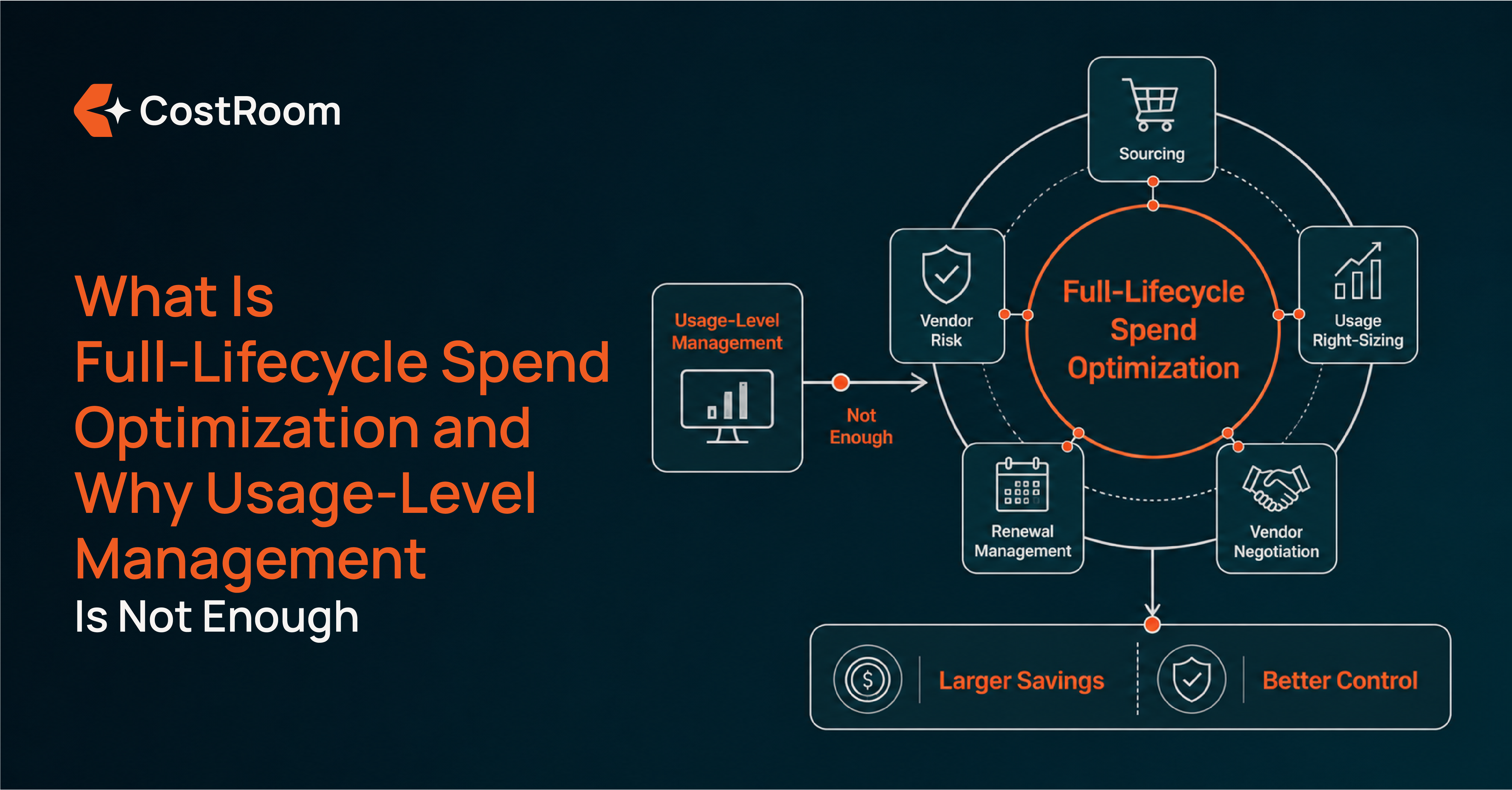
Most companies optimizing SaaS spend are doing it at the usage layer: auditing seat utilisation, identifying licences assigned to former employees, right-sizing subscription tiers to actual consumption. That work is worth doing. It is also the layer with the least leverage.
The largest savings in a SaaS and cloud portfolio come from somewhere else: the entry price set when a tool is first contracted, the negotiated terms that no one renegotiated at the second or third renewal, the compliance gap in a vendor agreement that has quietly compounded for two years. These are not usage problems. They are lifecycle problems, and usage-level management cannot reach them.
Full lifecycle spend optimization addresses all five layers of a vendor relationship, from the initial sourcing decision through renewal and risk. Each layer produces savings. Missing any one of them leaves money on the table in a way that no amount of licence auditing will recover.
What Is Full Lifecycle Spend Optimization?
Full lifecycle spend optimization is the practice of managing software and cloud vendor costs at every stage of the vendor relationship: from the initial sourcing decision and entry price, through usage right-sizing, vendor renegotiation, renewal management, and vendor risk. It produces consistently larger savings than usage-level management alone because it captures opportunity at every point in the vendor lifecycle, not just one.
The five layers are:
Sourcing. The entry price for a new tool, set at the moment of first contract, becomes the baseline for every future negotiation. Companies that source at list price because no benchmarking was done before signing are negotiating every subsequent renewal from an above-market starting point. Sourcing optimization sets the right entry price using market data and established vendor relationships before the contract is signed. For how a sourcing network changes what is possible at this stage, see How a Vendor Sourcing Network Gives Mid-Size Companies Buying Power They Don't Have Alone.
Usage right-sizing. Aligning contracted licences and cloud committed resources to actual consumption. This is the layer most SaaS optimization efforts address. It is necessary, and it is not sufficient on its own: a licence count correctly aligned to usage at a price that was never benchmarked still leaves the company paying more than it should.
Vendor negotiation. Bringing market benchmarks and renewal leverage to bear on vendor pricing across the portfolio. For SaaS and AI tools, this means knowing what comparable companies at the same scale and volume pay, and using that data in renewal conversations rather than accepting the vendor's opening position. For cloud infrastructure, this covers committed spend structures, reserved instance coverage, and enterprise agreement terms. For a dedicated guide to how vendor negotiation works in the optimization lifecycle, see SaaS and Cloud Vendor Negotiation: The Complete Guide for Mid-Size Companies.
Renewal management. Tracking renewal dates and notice periods across the full portfolio so that no tool auto-renews without a review. The window before renewal is when leverage exists. After the renewal executes, the terms are set for another year. A structured renewal process that surfaces every upcoming renewal 90 days in advance closes the window in which costs can compound without review. For the renewal management framework in full, see SaaS and Cloud Contract Renewal Management: The Complete Guide.
Vendor risk. Financial, compliance, security, and concentration risk across the portfolio. A vendor that is financially unstable, that holds data under terms that do not meet the company's regulatory requirements, or that represents a significant concentration risk in the tech stack carries costs that do not appear on any invoice until the risk materialises.
Why Usage-Level Management Is Not Enough
Usage management answers one question: is this tool being used? It does not answer whether the price is competitive, whether the contract terms reflect current market rates, whether the renewal date is being tracked before the notice period closes, or whether there is a compliance gap in the data handling arrangement.
The practical consequence is this: a company relying on usage tracking for spend management will discover at the next renewal cycle that it has been auto-renewing above-market contracts for tools that are actively used. The usage data cannot flag this problem. The tool is being used. The problem is not usage. The problem is that the price was never benchmarked, the renewal was never reviewed before it executed, and the contract has auto-renewed at list price for the second or third time.
Usage management identifies redundant licences. It does not identify whether the remaining licences were ever contracted at a competitive rate, or whether the vendor agreement was structured correctly when it was first signed. Those are sourcing and negotiation questions, and they require sourcing and negotiation answers.
How Lifecycle Optimization Works in Practice
The sequence matters because each layer builds on the one before it.
Start at sourcing. The entry price is the baseline for every future negotiation. A company that sources a tool at list price because no comparison to market rates was done before signing has established that above-market figure as the starting point for every renewal. Even a successful 10% reduction at the second renewal may still leave the company paying more than a well-sourced initial contract would have. Correcting a sourcing problem at renewal is possible; it is just harder and slower than not creating the problem at the outset.
Move to usage and negotiation. A tool at the right entry price, right-sized to actual consumption, with market benchmarking data brought to each renewal conversation, produces savings at three points rather than one. Each layer reinforces the others: benchmarked negotiation is more effective when usage data shows exactly what is consumed, and usage right-sizing is more meaningful when the price per unit is already at market rate.
Add renewal management. The 90-day window before each renewal is the only period when the company has meaningful leverage to change the terms. A renewal calendar that covers every tool, mapped to notice periods, ensures that every renewal enters the renegotiation window on schedule rather than being discovered after the auto-renewal has already executed.
Close the loop with risk management. A portfolio with clean compliance documentation, current financial assessments of key vendors, and identified concentration risks is in a structurally stronger position at every negotiation than one where compliance and risk data are held in separate systems or not tracked at all.
Lifecycle Optimization for AI, SaaS, and Cloud Together
The five lifecycle layers apply equally to AI tools, SaaS subscriptions, and cloud commitments. The mechanisms of each layer shift slightly by category: cloud infrastructure introduces committed spend structures and reserved instance coverage that SaaS tools do not have; AI tools add the variable pricing dimension of token and API-based billing that requires monitoring between renewal events rather than only at them.
But the structure of the optimization work is the same across all three. Sourcing at the right entry price matters as much for an AI subscription as it does for a SaaS tool. Vendor negotiation applies to cloud committed spend as much as to SaaS renewals. Renewal tracking applies to any contract that auto-renews.
Companies that manage all three categories through a single lifecycle process rather than three separate ones produce a consolidated view that makes each individual layer more effective. The leverage available from a company's full relationship with any vendor is only visible when the full portfolio is visible. For how managing all three categories together changes the optimization outcome, see Managing AI, SaaS, and Cloud Spend Together: A Guide for Mid-Size Companies. For the specific pattern of how AI tool costs accumulate outside standard management processes, see Why AI Tools Are Becoming Mid-Size Companies' Fastest-Growing Unmanaged Spend.
Optimize Across the Full Lifecycle
CostRoom covers every layer from sourcing to renewal, for SaaS, Cloud, and AI.
Frequently Asked Questions
What is full lifecycle spend optimization? Full lifecycle spend optimization is the practice of managing software and cloud vendor costs at every stage of the vendor relationship: from the initial sourcing decision and entry price, through usage right-sizing, vendor renegotiation, renewal management, and vendor risk. It produces consistently larger savings than usage-level management alone because it captures cost reduction opportunity at every point in the vendor lifecycle, not only at one.
How is lifecycle optimization different from SaaS usage management? Usage management addresses one layer of the lifecycle: whether tools are being used and whether licence counts match actual consumption. Lifecycle optimization addresses all five layers. The key distinction is that usage management cannot identify whether the price paid for an actively used tool is at market rate, or whether the contract will auto-renew without review. Sourcing, negotiation, and renewal management address the gaps that usage data cannot.
Why does the entry price matter so much in SaaS and software optimization? The entry price becomes the baseline for every future negotiation. A company that signs a contract at list price is negotiating all subsequent renewals against an above-market starting point. Even a successful renegotiation at renewal may still leave the company paying more than a properly sourced initial contract would have established. Lifecycle optimization that starts at sourcing removes this structural disadvantage before it compounds over multiple renewal cycles.
What does renewal management cover in the lifecycle? Renewal management covers tracking the renewal date and notice period for every active contract, surfacing each renewal 90 days in advance for review, and ensuring that no tool auto-renews without assessment of current pricing, usage, and contract terms. The 90-day window before renewal is when leverage exists. After the renewal executes, the terms are locked for the next contract period.
How does lifecycle optimization apply to cloud spend? Cloud spend has the same lifecycle structure as SaaS: entry pricing (committed spend structures and enterprise agreement terms), usage right-sizing (aligning committed resources to actual consumption and adjusting reserved instance coverage), vendor negotiation (renegotiating enterprise agreement terms and committed spend levels), renewal management (tracking annual committed spend renewals and contract milestones), and risk management (concentration risk from single-provider dependency). The mechanisms differ from SaaS at the usage layer, but the optimization structure is the same across all five layers.