There is a budget problem that affects most mid-size companies, and it has nothing to do with overspending. It has to do with under-visibility.
The average mid-size company manages well over a hundred SaaS tools. Add cloud infrastructure, AWS, Azure, GCP, or some combination, and you are looking at one of the largest controllable expenses in the business. The money is moving. Whether anyone is watching where it goes is another question entirely.
Most companies have partial answers to that question. Finance tracks some SaaS invoices. IT manages some cloud commitments. Procurement approves purchases as they arrive. But no single function owns the complete picture: SaaS and cloud together, from the moment a vendor is selected to the day a contract renews. That gap is precisely what spend optimization is designed to close.
This guide explains what SaaS and cloud spend optimization means, how it works in practice, and what it changes for companies at the 200–500+ employee stage.
What Is SaaS and Cloud Spend Optimization?
Spend optimization is the process of actively reducing and rationalising what a company pays for SaaS software and cloud infrastructure, covering every stage of procurement from initial vendor selection through contract renewal.
This is worth distinguishing from two things it is often confused with. Expense tracking records what a company has already spent; it is descriptive, not active. Procurement management structures how purchases get approved; it governs process, not outcome. Spend optimization asks a harder question than either: of everything your company is currently paying for, how much is necessary, correctly priced, and actively used?
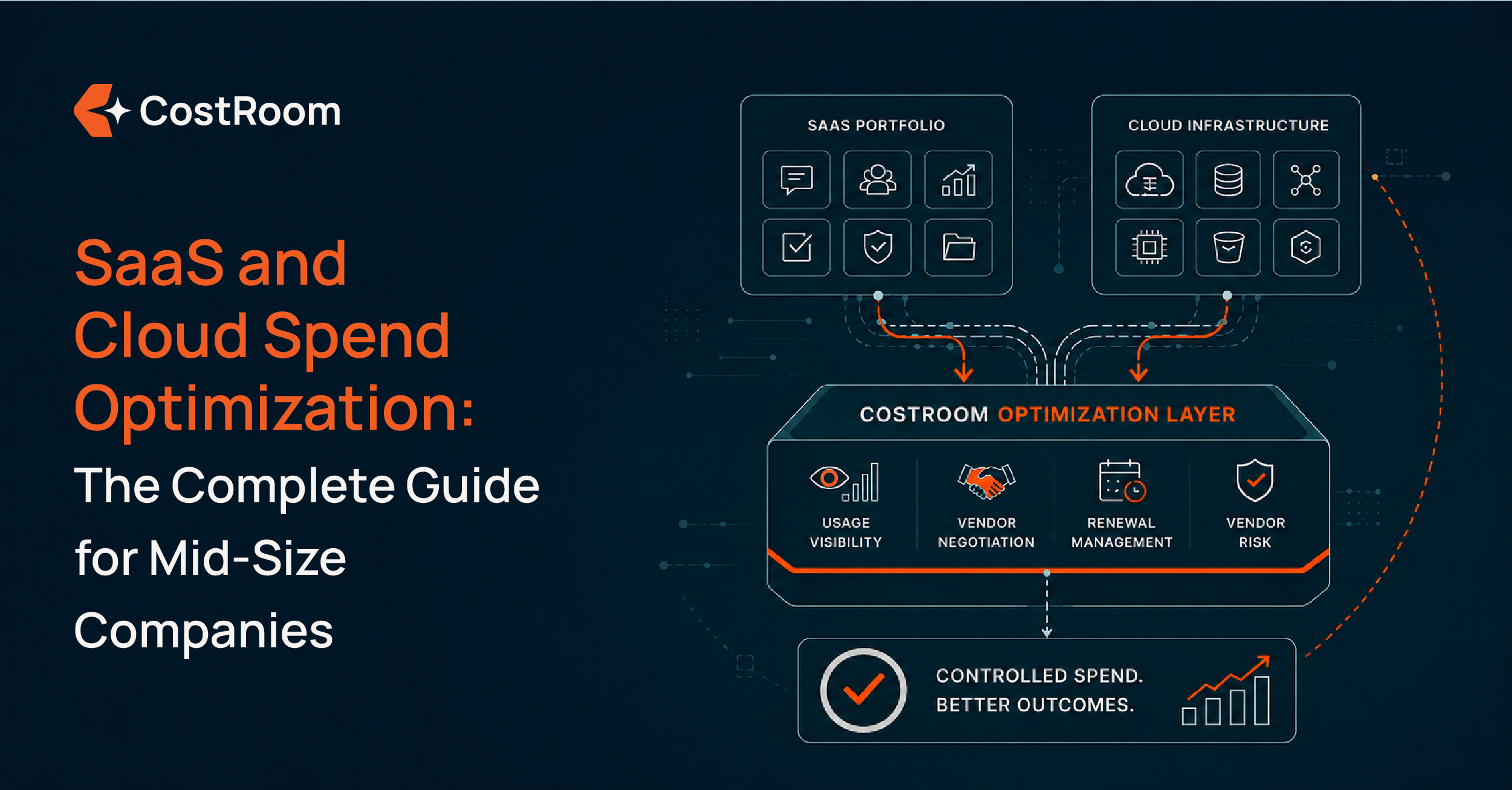
In practice, that means working across four distinct dimensions.
Usage visibility covers which tools and licences are underutilised or sitting completely idle. A significant share of SaaS licences at the average mid-size company go unused in any given month. On the cloud side, it means identifying over-provisioned resources, idle compute instances, and orphaned storage billed without serving any active function.
Pricing and negotiation involves benchmarking what the company currently pays against live market data, then using that intelligence to negotiate better terms. Many mid-size companies accept vendor pricing at face value, particularly at renewal, without the market data to push back effectively. Learn how CostRoom approaches SaaS and Cloud Vendor Negotiations.
Renewal management tracks the full contract cycle across the SaaS and cloud portfolio so that renewals become deliberate decisions rather than automatic ones. At a typical mid-size company, a significant number of tools come up for renewal every quarter. Without a structured process, the default outcome is the vendor's preferred outcome. See how CostRoom's Renewal Management product handles this.
Vendor risk examines which vendors in the stack create concentration risk, compliance exposure, or functional redundancy with other tools in the portfolio. This layer connects spend optimization to operational resilience in ways that pure cost management does not.
Each of these layers delivers value independently. Managed together, they compound in ways that individually scoped tools cannot replicate.
Why SaaS and Cloud Must Be Managed Together
Most approaches to spend management choose a lane. SaaS management tools track application usage and licence allocation. Cloud cost platforms optimise infrastructure spend and resource utilisation. Procurement systems govern the buying process. The result, in practice, is a three-tool stack that still leaves significant gaps, because none of these tools communicate with each other and none of them produce a complete picture.
The practical consequence of that fragmentation is significant. A company can have excellent SaaS governance and simultaneously be bleeding money on over-provisioned cloud resources that no one has reviewed in six months. A company with a well-managed cloud footprint can be paying for dozens of SaaS tools that duplicate each other's functionality across different departments.
Both SaaS and cloud now represent major, controllable cost lines for mid-size companies. Managing them from separate toolsets, with separate owners and separate review cycles, means they are never being optimised in concert. The opportunity that creates, and the cost of leaving it unaddressed, is larger than most CFOs expect when they first map it.
For a detailed breakdown of what the siloed approach costs and what a unified view changes, see: SaaS vs. Cloud Spend: Why Managing One Without the Other Is Costing You
The Four Layers of Spend Optimization
What separates a genuine optimization layer from any single tool in the stack is depth of coverage. Most spend management tools address one or two of these layers. A full-stack approach, like the one behind CostRoom's Spend Analysis and Optimization platform, covers all four.
Usage and Visibility
This is typically where companies start, and where many approaches stop. Usage visibility means knowing what the company is paying for, whether it is being used, and who owns it. For SaaS, that means licence-level tracking and utilisation data. For cloud, it means identifying idle compute, over-provisioned storage, and resources that are still billed but no longer serving active workloads.
The output of this layer is a list of things the company can cut or right-size without affecting operations. It is also the foundation for everything that follows: you cannot negotiate intelligently without accurate usage data, and you cannot manage renewals without knowing what you have.
Vendor Negotiation
Usage data is the input. Negotiation is where it becomes financial value. Vendor benchmarking compares what the company currently pays against market pricing for the same services, identifying where rates are above market and by how much. That data becomes the basis for renewal negotiations and, in some cases, forms the basis for mid-contract renegotiation where terms permit.
This layer is where mid-size companies typically leave the most money on the table. Without market intelligence, the negotiation dynamic defaults to the vendor's advantage; with it, the balance shifts considerably.
Renewal Management
The renewal layer is where mid-size companies lose money the most quietly. A contract signed 18 months ago auto-renews at the prior year's rate (or at an inflated rate that includes a price increase buried in the renewal notice) because no one flagged it in time to respond. Managing dozens of contracts reaching renewal every quarter is a challenge that spreadsheets and calendar reminders do not solve at scale.
Structured renewal management turns what is typically a reactive process into a proactive one: building a 12-month view of the renewal calendar, initiating conversations with vendors before renewal windows close, and ensuring that every contract that renews does so as a deliberate decision.
Vendor Risk
The fourth layer is often the least discussed. Vendor risk assessment examines which vendors in the stack represent concentration risk (single-vendor dependency for critical functions), compliance exposure (vendors handling sensitive data without adequate contractual protections), or functional redundancy (two or more vendors solving the same problem at different cost points).
This layer is not purely about cost reduction. It is about building a technology portfolio that is sustainable over time, not just optimised for the current quarter.
What Is a Spend Optimization Layer?
The phrase "optimization layer" describes how this approach sits within a company's existing infrastructure. It is not a replacement for the ERP, the finance system, or the IT management tools already in place. An optimization layer works across those existing systems, connecting data that currently lives in different places, applying market intelligence, and actively driving the outcomes that individual tools cannot produce in isolation.
This architecture matters for several reasons.
It means implementation is non-disruptive. The optimization layer adds capability to what is already in place rather than requiring a wholesale change to systems that took years to embed in the business.
It means the approach is genuinely vendor-agnostic. With no vendor partnerships, no OEM agreements, and no financial relationships with the suppliers it helps manage, the recommendations produced by an optimization layer are based entirely on market data and the company's specific spend profile. That independence is what makes the analysis credible, and it is what separates this model from a reseller or a managed service provider with preferred supplier arrangements.
For mid-size companies that cannot justify dedicated spend consultants or enterprise-grade procurement infrastructure, this model delivers analytical capability at a scale that matches their actual complexity, on a pricing structure that aligns incentives: a percentage of managed spend rather than a fixed subscription fee.
For a detailed explanation of how this works in practice, see: What Is a Spend Optimization Layer? A Plain-English Explanation
Three Misconceptions That Get in the Way
Three objections come up consistently when mid-size companies encounter spend optimization for the first time. Each is worth addressing directly, because each reflects a genuine misunderstanding of what the approach actually does.
"We already have procurement software."
Procurement software manages how purchases get approved: the workflow from request to purchase order to payment. Spend optimization manages whether those purchases are necessary, right-priced, and structured correctly. A company can have excellent procurement governance (every PO raised correctly, every vendor onboarded through the right process) and still be overspending significantly on its SaaS and cloud stack, because governance and optimization are different jobs.
A useful way to frame the distinction: procurement manages the process, optimization manages the outcome. The two are complementary, not interchangeable. See: Procurement Software vs. Spend Optimization: Why Having One Doesn't Mean You Have the Other
"We are too small for this."
Enterprise spend management tools are built for organisations with large procurement teams and dedicated category managers. They require significant implementation investment and ongoing internal resources to operate effectively. Spend optimization purpose-built for mid-size companies at the 200–500+ employee stage is a different offering: structured enough to handle a complex multi-vendor stack, lean enough to deliver results without a dedicated internal team to run it.
"Our SaaS management tool covers this."
SaaS management platforms provide licence-level visibility, which is valuable, but it represents one layer of the four described above. They do not negotiate pricing, they do not manage cloud infrastructure spend, and they do not produce the renewal intelligence needed to control contract cycles across a mixed SaaS and cloud portfolio. A usage tracker is the starting point for spend optimization; it is not a substitute for it.
India's IT spending is projected to exceed $176 billion in 2026, a year-on-year increase of more than 10%, driven substantially by mid-size companies scaling their cloud and SaaS usage in parallel with broader business growth. In the UAE and the wider Gulf region, similar dynamics are at play: digital transformation investments are accelerating the complexity of enterprise technology stacks at exactly the point where management infrastructure has not kept pace.
The competitive reality in these markets makes this particularly significant. The tools and approaches that dominate spend management globally are built for US enterprise buyers. Mid-size companies in India, the UAE, and KSA are managing increasingly complex SaaS and cloud stacks without access to solutions designed for their scale or their market conditions.
That gap will narrow eventually. It always does. The companies that build spend optimization capability now, before their SaaS and cloud portfolios grow further, will find themselves in a structurally better financial position than peers who address it later, at greater complexity and cost.
How to Get Started
The right starting point for any spend optimization effort is clarity on current spend. That means mapping every SaaS and cloud contract, licence, and commitment in one place, including the portion that typically exists outside the formal procurement process and is not visible to finance or IT in any structured way.
A spend analysis does this work upfront. It surfaces what the company is paying across SaaS and cloud, where pricing is above market rate, which contracts are approaching renewal, and what the total optimization opportunity looks like, before any commitment to a service or platform is made. It is the equivalent of a financial health check for the technology stack.
For companies managing a large portfolio of tools across SaaS and cloud, this exercise typically reveals more complexity and more opportunity than expected. That is not a reflection of poor management. It is a reflection of how rapidly modern SaaS and cloud stacks grow when no single function holds the complete picture.
Frequently Asked Questions
What is SaaS and cloud spend optimization?
SaaS and cloud spend optimization is the process of actively reducing and managing what a company pays for SaaS software and cloud infrastructure across every stage of procurement, from vendor selection through contract renewal. It covers four layers: usage visibility (what is actually being used), vendor negotiation (whether current pricing is at market rate), renewal management (whether contracts renew on the company's terms), and vendor risk (whether the stack is compliant and appropriately consolidated).
How is spend optimization different from expense tracking? Expense tracking records what a company has already spent. It is descriptive. Spend optimization is active: it works to reduce costs, improve contract terms, prevent missed renewals, and eliminate waste before the next invoice arrives. The distinction matters because tracking a problem and solving it are two different jobs.
Why should SaaS and cloud spend be managed together, not separately? SaaS and cloud are typically the two largest controllable IT cost lines at a mid-size company. Managing them separately means neither is ever optimised in concert: SaaS management tools do not see cloud infrastructure costs, cloud cost tools do not see SaaS contracts or renewal dates, and vendors who supply services at both levels are never negotiated with full leverage.
Do mid-size companies need spend optimization if they already have a procurement team? Yes. A procurement team manages the buying process: approvals, purchase orders, vendor onboarding. Spend optimization manages the outcomes of that process: whether tools are still in use, whether prices remain at market rate, and whether renewals are handled proactively. The two functions address sequential stages of the same challenge and work best in combination.
How much can a mid-size company save through spend optimization? Savings depend on the size and complexity of the SaaS and cloud portfolio, current contract terms, and the number of renewals approaching without active management. CostRoom does not state a guaranteed figure. The free spend analysis provides a specific, company-level view of the optimization opportunity before any commitment is made.
Related reading: