Most mid-size companies negotiate their SaaS and cloud renewals. Fewer than you might expect negotiate the entry price: the price agreed at the moment a new tool is first contracted.
By the time renewal arrives, list price has become the baseline. The vendor treats the existing contract as the starting point. The buyer treats the existing contract as the starting point. Both sides negotiate from a number that was never benchmarked against market rates because no sourcing process compared the initial price to what comparable companies at the same size and volume actually pay.
That sourcing decision, made before any formal procurement review began, sets a ceiling on every negotiation that follows. Removing it requires going back to the beginning: sourcing the next tool correctly, or renegotiating the existing baseline before the next renewal cycle locks it in again.
For mid-size companies without dedicated procurement teams or established vendor relationships across hundreds of SaaS, Cloud, and AI vendors, sourcing at market rate requires something external. That is what a vendor sourcing network provides.
What Is a Vendor Sourcing Network?
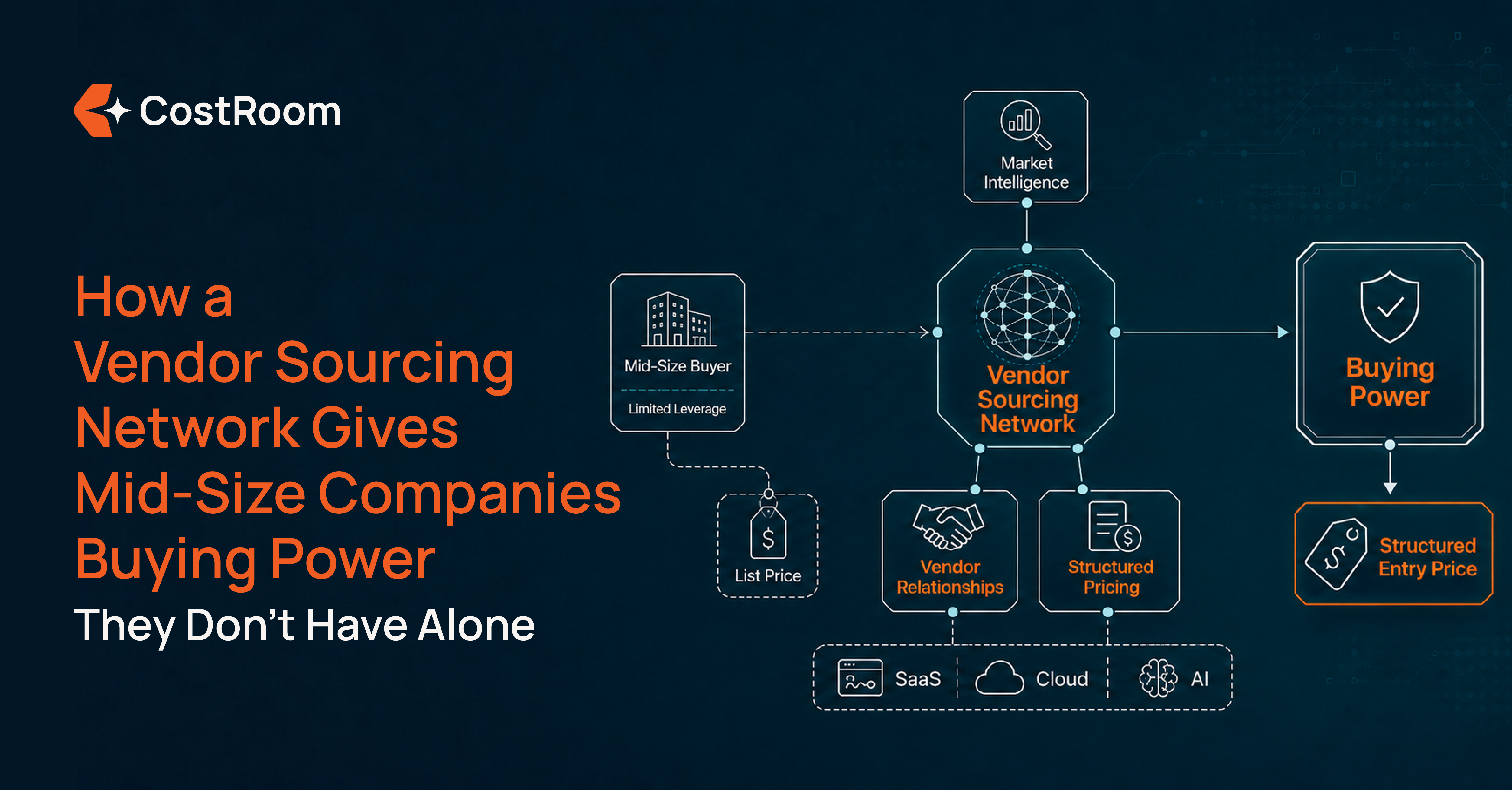
A vendor sourcing network is a set of established relationships with SaaS, Cloud, and AI vendors that gives buyers access to structured pricing and live market intelligence at the sourcing stage, before a contract is signed. Unlike a reseller relationship or a vendor marketplace, a sourcing network earns nothing from vendors and holds no commercial agreements that would bias its recommendations.
CostRoom's sourcing network covers more than 100 SaaS, Cloud, and AI vendors, and that number grows as the vendor landscape expands. The network carries no OEM agreements and no commercial relationships with vendors. CostRoom does not earn from vendor referrals, holds no exclusivity arrangements, and recommends tools based solely on client data and market fit. The sourcing recommendation reflects what the data says, not what any vendor relationship incentivises.
This distinction matters because the alternative, a marketplace or reseller that earns commission from vendors, has an inherent structural bias. The recommendation that benefits the platform financially is not always the recommendation that benefits the buyer. A sourcing network that earns nothing from vendors has no such conflict. The benefit flows entirely to the client.
Why the Entry Price Matters More Than the Renewal Rate
Every vendor negotiation starts from the existing contract as a baseline. The vendor's opening position at renewal is typically the current contract price plus an uplift. The buyer's opening position is the current contract price minus whatever reduction they can justify. Both positions anchor to the number agreed at signing.
A company that first contracted a tool at list price because no benchmarking was done before signing has set that above-market figure as the permanent starting point. Even a successful 10% reduction at the second renewal may still leave the company paying above where a well-sourced initial contract would have started. The structural disadvantage compounds with each renewal cycle that leaves the above-market baseline in place.
Sourcing at the right entry price removes this problem at the source. A tool contracted at a structured rate, reflecting actual market benchmarks and established vendor relationships rather than the vendor's published price list, starts every subsequent renewal from a defensible position. The negotiation at renewal then produces incremental improvement rather than partial correction of an original pricing error.
There is one other consequence of above-market entry pricing that compounds differently: it affects every seat added after the original contract. Each expansion to the tool's licence count typically prices from the existing per-unit rate. An above-market entry price is not a one-time cost; it recurs at each expansion event until the rate is renegotiated.
What Sourcing Network Access Changes in Practice
Three things change when a mid-size company sources through an established vendor network rather than approaching vendors directly.
Structured pricing replaces list price. Vendors in an established network relationship provide structured pricing tiers to qualified buyers. These tiers reflect volume, sector, and relationship context that is invisible to a company approaching the same vendor for the first time. The gap between list price and structured pricing varies by vendor and category, but it is consistently material in SaaS and AI tools, where published pricing is rarely what informed buyers pay.
Market intelligence reflects actual rates. The benchmarking data used in any negotiation is only as accurate as the underlying market data. A company negotiating from published price lists as a benchmark is negotiating from the least accurate data available, because those lists represent the maximum rate rather than the market rate. An active sourcing network with relationships across 100+ vendors holds current rate data across categories and geographies, which means the benchmark brought to each negotiation reflects what comparable companies actually pay, not what vendors would prefer them to pay.
Account team relationships create timing access. The most important negotiating variable in any SaaS or AI renewal is not the argument made at the table; it is the timing of when the conversation begins. Vendors who know a renewal is approaching and who have an established relationship with a buyer's representative are more likely to engage on pricing before the auto-renewal executes. Companies without those relationships often discover, after a renewal has already processed, that the window for renegotiation has closed. Established network relationships open that window consistently and reliably, regardless of whether the buyer has dealt with the vendor directly before.
Sourcing as the First Layer of Lifecycle Optimization
Sourcing is not a separate activity from spend optimization. It is the first layer of a five-layer process that runs from entry pricing through usage right-sizing, vendor negotiation, renewal management, and vendor risk. A tool sourced at the right entry price, with a correctly structured initial contract, is easier to renegotiate at renewal, easier to right-size when consumption changes, and carries less compliance risk because the original agreement was reviewed and structured before signing.
Companies that engage an optimization process only at the renewal stage are correcting, at each cycle, a pricing problem that sourcing discipline would have prevented at the outset. The correction is possible. It is slower, more expensive in negotiation effort, and leaves several renewal cycles of above-market spend permanently behind.
For how sourcing fits within the full lifecycle optimization framework, see What Is Full-Lifecycle Spend Optimization and Why Usage-Level Management Is Not Enough. For how vendor negotiation works as the layer that follows sourcing, see SaaS and Cloud Vendor Negotiation: The Complete Guide for Mid-Size Companies. For the full guide to managing AI, SaaS, and cloud spend across all five layers, see Managing AI, SaaS, and Cloud Spend Together: A Guide for Mid-Size Companies.
The spend analysis is where this work starts. It maps the current portfolio, identifies tools that were sourced at above-market entry prices, and produces a prioritised action plan covering which contracts to renegotiate, which renewals fall within the next 90 days, and which new tools should be sourced through the network rather than at list price.
Get Structured Pricing From Day One
CostRoom's vendor sourcing network gives mid-size companies structured rates across 100+ SaaS, Cloud, and AI vendors.
Frequently Asked Questions
What is a vendor sourcing network for SaaS? A vendor sourcing network is a set of established relationships with SaaS, Cloud, and AI vendors that gives buyers access to structured pricing and live market intelligence at the sourcing stage, before a contract is signed. It is not a reseller arrangement or a vendor marketplace. A sourcing network that earns nothing from vendors holds no commercial bias toward any particular tool or provider. The benefit of the network flows entirely to the buyer, in the form of structured entry pricing and accurate market rate data.
How does a sourcing network help companies get better SaaS prices? A sourcing network provides three advantages that direct vendor approaches do not: structured pricing tiers rather than list price, market intelligence reflecting actual rates rather than published prices, and account team relationships that create access to negotiate before a contract auto-renews. Each advantage addresses a specific gap in how mid-size companies without dedicated procurement resources typically source new tools.
Why do mid-size companies pay list price for SaaS tools? Most mid-size companies approach new vendors without benchmarking data, without established vendor relationships, and without a formal sourcing process that precedes the purchase decision. The vendor's published price list becomes the reference point by default, because no alternative benchmark exists. A sourcing network replaces the published price list with current market rate data and structured pricing tiers that reflect the rates informed buyers actually pay.
How do mid-size companies get buying power for software sourcing? Mid-size companies access buying power by using a vendor sourcing network that holds established relationships across a large number of vendors simultaneously. An individual company sourcing a single SaaS tool has limited leverage. A sourcing network that works across many client relationships and maintains active vendor relationships has access to structured pricing and market data that individual buyers cannot replicate independently. CostRoom's sourcing network of 100+ SaaS, Cloud, and AI vendors makes this access available to mid-size companies without enterprise procurement teams.
Is using a vendor sourcing network the same as using a reseller? No. A reseller earns commission from vendors on each transaction, which creates a structural incentive to recommend the vendors that pay the highest commission rather than the tools that best fit the buyer's requirements. A sourcing network that holds no OEM agreements and earns nothing from vendor referrals has no such incentive. CostRoom's sourcing network operates on this basis: no commercial relationships with vendors, no commissions, no exclusivity arrangements. The recommendation reflects only client data and market fit.