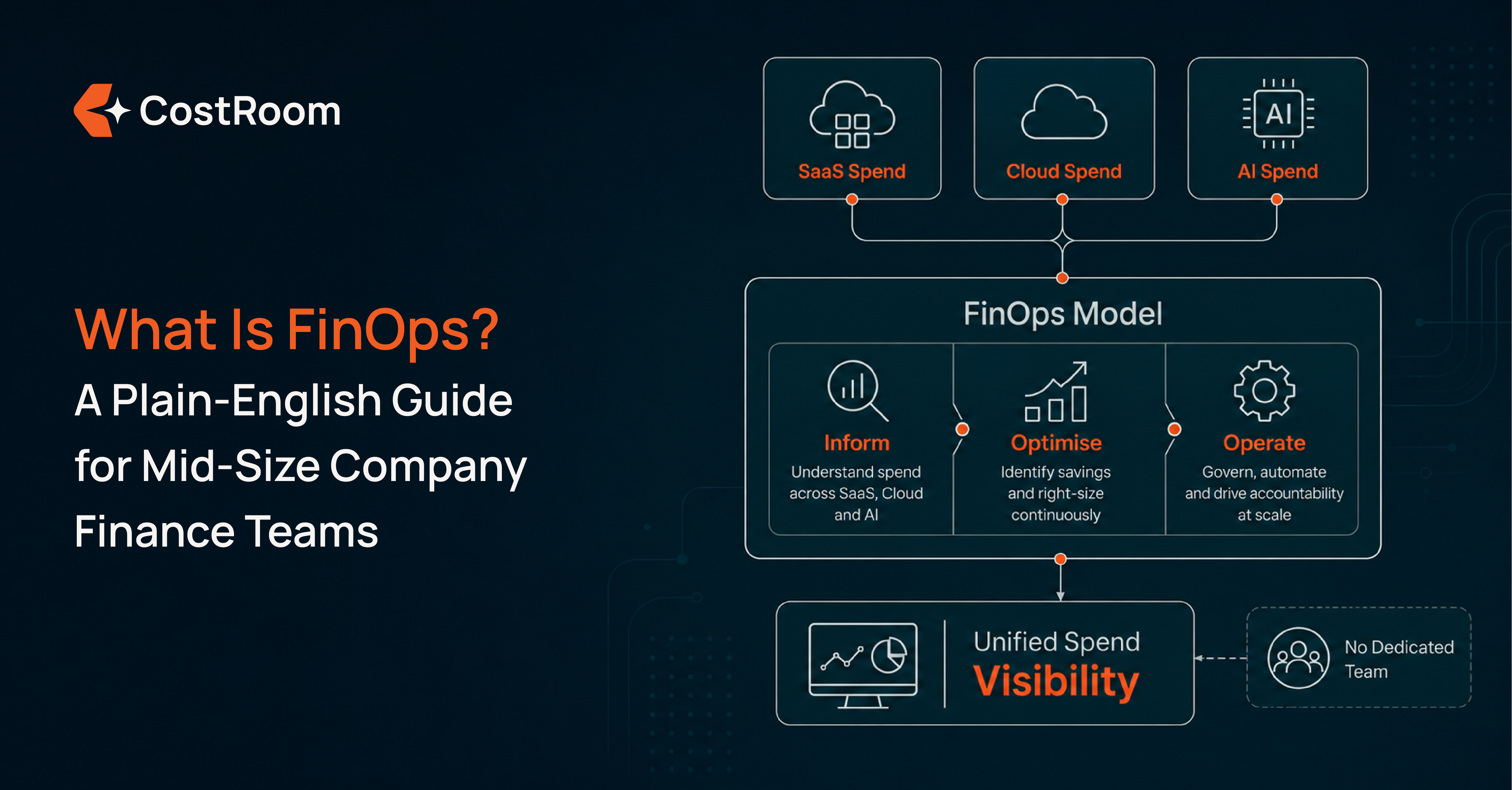
If you have searched for FinOps recently, you have probably found two types of content: enterprise implementation guides written for cloud engineering teams, and vendor overviews designed to sell FinOps platforms. Neither is written for the CFO, IT Director, or Finance Manager at a company of 200 to 500 people who has started hearing the term and wants to understand what it actually means.
This guide explains what FinOps is, how it has evolved, and what the discipline means in practice for a mid-size company that does not have a dedicated cloud engineering function.
What Is FinOps?
FinOps, short for cloud financial operations, is a discipline that helps organisations manage the cost and value of their technology spend through shared accountability between finance, engineering, and business teams. The FinOps Foundation defines it through three phases: Inform (build visibility into what you are spending and where), Optimise (eliminate waste and align contracts to actual usage), and Operate (embed cost discipline as a continuous practice rather than a periodic project).
The framework began as a response to a specific problem: cloud spending at large enterprises was growing faster than anyone could track or control. Infrastructure teams could provision resources in minutes; finance teams received consolidated invoices weeks later. FinOps was designed to close this accountability gap by bringing engineers, finance, and business leaders into a shared model for managing cloud costs.
The FinOps Foundation, the industry body that defines and advances the discipline, was established in 2019. Its membership includes practitioners from enterprises running some of the world's largest cloud footprints, and its certification and training programmes have become the standard for organisations building dedicated FinOps functions.
What Does FinOps Cover in 2026?
FinOps now covers SaaS, cloud, and AI spend together. The FinOps Foundation formally updated its mission in 2026 from "advancing the people who manage the value of cloud" to "advancing the people who manage the value of technology," a recognition that cloud infrastructure is no longer the only spend category requiring active financial discipline. According to the 2026 State of FinOps report (1,192 respondents, $83 billion in represented cloud spend), 90% of practitioners now manage SaaS spend, up from 65% the prior year, and 98% manage AI spend, up from 31% just two years earlier.
This expansion reflects a structural reality most finance teams are already experiencing: SaaS subscriptions renewing automatically across departments, cloud invoices with line items no one can fully explain, and AI tool costs arriving through expense accounts because no formal contract was ever signed. The spend categories have multiplied; the discipline has caught up.
The practical implication for mid-size companies is that technology spend optimisation, in 2026, cannot stop at cloud. A company that has addressed its cloud costs but has not reviewed its SaaS portfolio or mapped its AI tool spending has an incomplete picture of what it is spending on technology each year. For the specific pattern of how AI tool costs accumulate outside standard management processes, see Why AI Tools Are Becoming Mid-Size Companies' Fastest-Growing Unmanaged Spend.
Why Mid-Size Companies Are Researching FinOps Now
For most of its history, FinOps was an enterprise concern. The companies investing in FinOps functions were those with cloud bills large enough to justify dedicated practitioners: technology companies, financial institutions, and large enterprises spending tens of millions of dollars annually on cloud infrastructure.
That has changed. Mid-size companies (200 to 500 or more employees) now routinely manage SaaS portfolios of 50 or more tools, cloud commitments across one or more providers, and a growing number of AI subscriptions across departments. The total technology spend for companies in this range commonly sits between five million and twenty million dollars annually. At that scale, unreviewed spend, above-market pricing at renewal, and uncontracted spend accumulating below procurement thresholds add up to a material exposure.
FinOps is entering the mid-size conversation not because these companies are suddenly cloud-native enterprises but because the vocabulary of spend visibility, right-sizing, and optimisation is the right framing for the problem they are actually experiencing. The question is what the implementation looks like when a dedicated FinOps team is not an option. For a full picture of how FinOps principles apply at mid-size scale, see FinOps for Mid-Size Companies: Managing SaaS, Cloud, and AI Spend.
What the Three FinOps Phases Mean in Practice
The three-phase model (Inform, Optimise, Operate) describes a maturity arc applicable to any organisation, regardless of size.
Inform means building a complete, current picture of what the company is spending on technology and where. For a mid-size company, this means mapping every active SaaS subscription, cloud commitment, and AI tool, along with current pricing relative to market benchmarks, renewal dates, and any compliance flags for tools handling sensitive data. This is the working document from which every subsequent action is built. For a detailed look at how Inform works across all three spend categories together, see Managing AI, SaaS, and Cloud Spend Together: A Guide for Mid-Size Companies.
Optimise means acting on what the Inform phase surfaces: reducing waste by eliminating unused licences and over-provisioned resources, renegotiating contracts where pricing is above market, and sourcing new tools at structured rates rather than at list price. Right-sizing unused licences is necessary but not sufficient; a licence count correctly aligned to usage at a price that was never benchmarked still leaves the company paying more than the market rate.
Operate means maintaining the discipline continuously rather than as an annual project. This requires a renewal calendar that surfaces every upcoming renewal 90 days in advance, an ongoing benchmarking process that tracks market rate movements, and a vendor risk framework that covers AI alongside SaaS and cloud. For the complete guide to how ongoing spend management works across the portfolio, see SaaS and Cloud Spend Optimisation: The Complete Guide for Mid-Size Companies.
Not Sure Where Your Technology Spend Sits Across These Stages?
CostRoom maps your SaaS, Cloud, and AI spend and shows you exactly what the optimisation opportunity looks like.
Why the Standard FinOps Model Is Hard to Implement at Mid-Size Scale
The standard FinOps implementation model assumes a centralised FinOps team with dedicated practitioners, engineering-level accountability for cloud costs at team or project level, and real-time billing data infrastructure that attributes costs across hundreds of resources. Building this from scratch requires hiring practitioners, aligning engineering teams, implementing tooling, and establishing governance policies.
For a company managing five to twenty million dollars in annual technology spend, that investment is disproportionate relative to the spend it would manage. The FinOps ROI story at mid-size scale is still strong: the savings opportunity is real, and the optimisation gap is often larger than any initial estimate. The staffing model typically assumed is not. Most companies at this scale do not have a cloud centre of excellence, a DevOps team organised around cost accountability, or a finance function with the bandwidth to manage real-time cloud billing.
This does not mean the FinOps discipline is wrong for mid-size companies. It means the implementation path is different.
What Mid-Size Companies Use Instead
The outcome FinOps delivers, reduced technology costs, better pricing at renewal, complete visibility across the portfolio, and active management of vendor risk, is achievable at mid-size scale without building an in-house FinOps function.
A vendor-agnostic optimisation layer applies the same Inform, Optimise, Operate principles across SaaS, cloud, and AI without requiring the headcount investment. It carries no commercial relationships with vendors, holds no OEM agreements, and produces recommendations based only on client data and current market conditions. The sourcing dimension adds something an in-house FinOps team cannot replicate alone: established relationships across a large number of vendors simultaneously, with current market rate data that makes new tool sourcing and renewal benchmarking materially different from accepting a vendor's opening position.
For a mid-size company researching FinOps, the relevant question is not whether to build a FinOps team but whether the same outcomes are accessible through a model that fits the organisation's size, resources, and risk profile. For a deeper look at why usage-level management on its own is not enough, see What Is Full-Lifecycle Spend Optimisation and Why Usage-Level Management Is Not Enough. To understand what the analysis stage looks like in practice, see the Spend Analysis and Optimisation overview.
See Your Full Technology Spend Picture
CostRoom maps SaaS, Cloud, and AI spend together, then optimises across every layer from sourcing to renewal.
Frequently Asked Questions
What does FinOps stand for?
FinOps stands for cloud financial operations. It is a discipline that helps organisations manage the cost and value of their technology spend through shared accountability between finance, engineering, and business teams. The FinOps Foundation, established in 2019, defines and advances the discipline through certification, training, and community resources.
Is FinOps only for cloud spend?
FinOps began as a cloud cost management discipline but has formally expanded to cover SaaS and AI spend. The FinOps Foundation updated its mission in 2026 to reflect this shift, moving from "cloud" to "technology" as the scope of the discipline. As of 2026, 90% of FinOps practitioners manage SaaS spend and 98% manage AI spend, according to the Foundation's 2026 State of FinOps report.
Does a mid-size company need a dedicated FinOps team?
For most mid-size companies, a dedicated FinOps team is not the right model. FinOps teams are the right structure for organisations managing very large cloud footprints where the savings opportunity justifies specialist headcount. Mid-size companies typically achieve the same outcomes through a vendor-agnostic optimisation layer that covers SaaS, cloud, and AI without requiring a dedicated internal function.
What is the difference between FinOps and SaaS management?
SaaS management typically refers to tooling that tracks licence utilisation, application usage, and renewal dates within the SaaS portfolio. FinOps is a broader discipline covering the full spend optimisation lifecycle: visibility, right-sizing, vendor negotiation, renewal management, and risk assessment. In 2026, FinOps has formally expanded to include SaaS alongside cloud and AI, meaning the two disciplines are increasingly addressed together rather than as separate programmes.