FinOps was designed around a specific organisational model: a cloud-native company with dedicated engineering teams, a centralised FinOps practice, and a finance function equipped to track variable infrastructure costs in real time. For companies managing $100 million or more in annual cloud spend, that structure makes sense and pays for itself.
Most mid-size companies are not that company. They have SaaS subscriptions spread across departments, cloud invoices that arrive as surprises to the CFO, and AI tool costs entering the budget at list price through team expense accounts. No single person has a complete picture of what the company is spending on technology. The spend is real. The opportunity to reduce it is real. What is missing, in most cases, is not a framework: it is the capability to act on one.
The FinOps discipline is evolving to address this. In 2026, the FinOps Foundation updated its mission from "advancing the people who manage the value of cloud" to "advancing the people who manage the value of technology," a formal acknowledgment that SaaS, AI, and licensing now fall under the same financial discipline as cloud infrastructure. The scope has caught up with reality. The implementation model has not yet followed.
This guide covers what FinOps for mid-size companies actually requires, where the standard framework falls short, and what a full-lifecycle approach to technology spend looks like for companies that cannot build a FinOps team from scratch.
What Is FinOps?
FinOps, short for cloud financial operations, is a discipline that helps organisations manage the cost and value of their technology spend through shared accountability between finance, engineering, and business teams. It moves cost management from a reactive quarterly review into a continuous operational practice, where spending decisions are informed, optimisation is ongoing, and accountability for costs sits with the people who incur them.
The FinOps Foundation defines three phases: Inform (build visibility into what you are spending and where), Optimise (eliminate waste and align contracts with actual usage), and Operate (embed cost discipline as a continuous practice rather than a periodic project). Each phase builds on the one before it. Visibility enables optimisation; optimisation sustained over time becomes operational discipline.
The framework was originally built for cloud infrastructure, and cloud is still where most FinOps tooling and most FinOps practitioners focus their work. But cloud-only management, in 2026, produces an incomplete picture for any organisation also running a SaaS portfolio and AI subscriptions. The FinOps Foundation recognised this directly: SaaS now falls within the FinOps remit for 90% of practitioners, and AI spend is managed by 98%, both numbers having grown by 25 percentage points or more in a single year, according to the 2026 State of FinOps report (1,192 respondents, $83 billion in represented cloud spend).
The discipline is right. The question is whether its implementation model works for a company of 200 to 500 people without a cloud centre of excellence.
How FinOps Has Expanded Beyond Cloud in 2026
The FinOps Foundation's 2026 mission update was not a marketing statement. It reflected a structural shift in how organisations manage technology costs: cloud is no longer the only spend category that requires active financial discipline, and SaaS and AI have grown to a scale where managing them separately from cloud produces a materially incomplete view of technology expenditure.
The numbers from the 2026 State of FinOps report illustrate the pace of this shift. Two years ago, 31% of FinOps practitioners managed AI spend. In 2026, that figure is 98%. SaaS went from 65% to 90% within a single year. Practitioners describe the evolution in phases: first they were asked to address cloud costs, then SaaS, then licensing, then AI. Each expansion arrived not from a strategic decision but from the recognition that unmanaged spend in each category was large enough to demand attention.
This is the context mid-size companies are navigating. SaaS pricing is becoming more variable, with vendors shifting toward consumption-based models that make costs harder to forecast. AI billing introduces token and API charges that can change materially within a contract period without any renewal event. Cloud committed spend requires its own optimisation cycle around reserved instances and enterprise agreement terms. Managing each separately means the full picture of what a company is spending on technology exists nowhere in a single view.
The FinOps discipline offers the right framing for addressing this. The enterprise implementation model it assumes is a different matter.
Why the Standard FinOps Model Does Not Work for Mid-Size Companies
The FinOps model, as typically implemented at enterprise scale, assumes several things: a centralised FinOps team with dedicated practitioners, engineering accountability for cloud costs at the team or project level, cross-functional collaboration between finance and DevOps, and tooling that ingests billing data from cloud providers and produces real-time cost attribution across hundreds of resources.
Mid-size companies (200 to 500 or more employees) typically have none of this infrastructure in place. They have a CFO who wants visibility into technology spend but receives fragmented information from IT, finance, and department heads who each see part of the picture. They have cloud bills that arrive from AWS or Azure without the tagging and cost allocation structure that makes FinOps optimisation possible. They have SaaS tools purchased by individual departments below the approval threshold, renewing automatically each year without review. They have AI subscriptions that someone expensed six months ago and that are now in production workflows with no formal contract.
Building a FinOps practice from scratch requires hiring practitioners, aligning engineering teams, implementing tooling, and establishing governance policies. For a company managing $5 million to $20 million in annual technology spend, that investment is disproportionate relative to the spend it would manage. The FinOps ROI story at mid-size is still strong: the savings opportunity is real. The staffing model typically assumed is not.
This is the gap the standard FinOps literature does not address. The discipline is right. The assumption that every organisation can and should build a FinOps team is enterprise-specific, and it leaves mid-size companies without a workable path to the outcome FinOps is designed to produce.
What Technology Spend Optimisation Covers at Mid-Size Scale
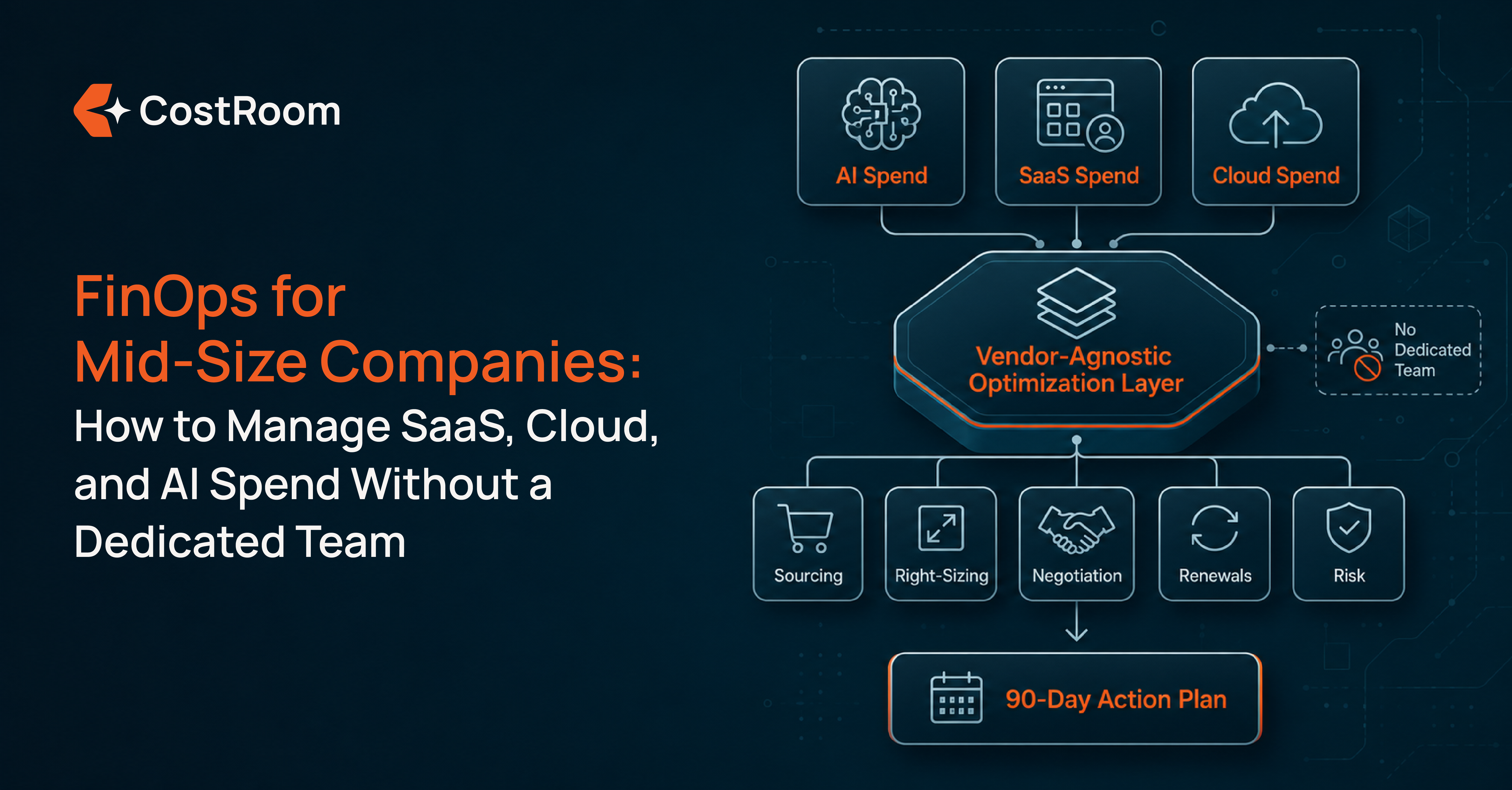
The outcome that FinOps delivers is achievable for mid-size companies: reduced technology costs, better pricing at renewal, complete visibility across the portfolio, and active management of risk. The path to it does not run through building a FinOps team; it runs through applying the same principles across a five-layer optimisation model suited to mid-size scale and mid-size resource constraints.
Sourcing. The entry price for any SaaS, cloud, or AI tool, the price agreed when the first contract is signed, becomes the baseline for every future negotiation. Companies that source at list price because no benchmarking was done before signing are negotiating every subsequent renewal against an above-market starting point. A sourcing process that uses current market data and established vendor relationships before contract signature removes this structural disadvantage before it compounds. For a detailed look at what sourcing optimisation changes in practice, see How a Vendor Sourcing Network Gives Mid-Size Companies Buying Power They Don't Have Alone.
Usage right-sizing. Aligning contracted licences and cloud committed resources to actual consumption. This is the layer most SaaS optimisation efforts address, and it is necessary: unused licences and over-provisioned resources represent direct, recoverable spend. It is also not sufficient on its own. A licence count correctly aligned to usage at a price that was never benchmarked still leaves the company paying more than market rate. Right-sizing at the wrong price recovers less than it appears to.
Vendor negotiation. Bringing market benchmarks and renewal leverage to bear on pricing across the portfolio. For SaaS and AI tools, this means knowing what comparable companies at the same scale and volume actually pay, and using that data in renewal conversations rather than accepting the vendor's opening position. For cloud, it covers committed spend structures, reserved instance coverage, and enterprise agreement terms. Benchmarking without negotiation is analysis that produces no outcome. Negotiation without benchmarking is guesswork.
Renewal management. Tracking renewal dates and notice periods across the full portfolio, covering SaaS, cloud, and AI, so that no tool auto-renews without a review. The window before renewal is the only point in the contract lifecycle where leverage exists. After the renewal executes, the terms are locked for another year. A structured renewal calendar that surfaces every upcoming renewal 90 days in advance closes the gap in which costs compound without anyone reviewing them.
Vendor risk. Mapping financial, compliance, security, and concentration risk across the full portfolio. AI tools in particular carry compliance dimensions that SaaS tools typically do not: data handling requirements, acceptable use constraints, and regulatory exposure that grows the longer an unreviewed tool processes business data. A vendor risk framework that covers AI alongside SaaS and cloud produces a complete risk picture; one that covers only cloud and SaaS is increasingly incomplete.
The FinOps discipline covers layers two and three well for cloud infrastructure. Mid-size companies need coverage of all five layers, across all three spend categories, without the assumption of a dedicated internal team to manage them. For a deeper look at how the five layers work together, see What Is Full-Lifecycle Spend Optimisation and Why Usage-Level Management Is Not Enough.
What a Vendor-Agnostic Optimisation Layer Provides
A company building a FinOps function in-house is making a staffing and tooling investment. That investment pays off at scale. Below a certain technology spend threshold, the cost of the function approaches the savings it produces, and the company is hiring practitioners to manage a problem rather than solving it.
A vendor-agnostic optimisation layer provides the capability set that FinOps delivers without the headcount requirement. It operates across SaaS, cloud, and AI spend from a single point of visibility. It carries no commercial relationships with vendors and holds no OEM agreements that would create a structural bias toward any particular tool or provider. The recommendation it produces reflects only client data and current market conditions.
The sourcing dimension adds something a FinOps tool cannot replicate: established relationships across a large number of vendors simultaneously. CostRoom's sourcing network covers more than 100 SaaS, Cloud, and AI vendors, with current market rate data across categories. This means new tools can be sourced at structured rates rather than at list price, and benchmarking for existing renewals reflects what comparable companies actually pay rather than what vendors publish as their starting position.
This distinction between tools and managed expertise matters for mid-size companies specifically. A FinOps platform surfaces the data. An optimisation layer acts on it: running negotiations, managing renewal calendars, assessing vendor risk, and sourcing new tools at rates that remove the above-market baseline problem before it compounds across multiple renewal cycles.
For context on how managing SaaS, cloud, and AI as a unified portfolio changes what is achievable at mid-size scale, see Managing AI, SaaS, and Cloud Spend Together: A Guide for Mid-Size Companies. For the specific pattern of how AI tool costs accumulate outside standard management processes before they become visible, see Why AI Tools Are Becoming Mid-Size Companies' Fastest-Growing Unmanaged Spend.
See Your Full Technology Spend in One View
CostRoom maps SaaS, Cloud, and AI spend together, then optimises across every layer from sourcing to renewal.
Getting Started: Technology Spend Analysis Before Optimisation
The FinOps "Inform" phase (building visibility before attempting to optimise) is the right sequence for any organisation. For a mid-size company without existing cost attribution infrastructure, it means starting with a complete, current picture of what the company is actually spending across SaaS, cloud, and AI, before any negotiation or optimisation work begins.
What the spend analysis covers: every active SaaS subscription, cloud commitment, and AI tool across the portfolio; current cost and pricing relative to current market benchmarks; renewal dates and auto-renewal clauses; compliance flags for tools handling sensitive data; and uncontracted spend that has been accumulating below the procurement review threshold. The output is a prioritised action plan: which renewals fall within the next 90 days, which contracts should be renegotiated before they auto-renew, which AI subscriptions have compliance gaps, and which new tools should be sourced through the vendor network rather than at list price.
This is not a report that gets filed. It is the working document from which the renewal management schedule, the negotiation calendar, and the right-sizing programme are all built. Most companies completing this analysis for the first time find two things simultaneously: their total technology spend is higher than any budget estimate, and the optimisation opportunity across all three categories is larger than any single-category review would have surfaced.
For context on how the full spend optimisation framework applies specifically to SaaS and cloud, see SaaS and Cloud Spend Optimisation: The Complete Guide for Mid-Size Companies.
The starting point is the analysis. The optimisation work follows from what it reveals.
FinOps is the right discipline. The question mid-size companies are working through is how to access what it delivers without the enterprise infrastructure it was designed around. The answer is not to build a smaller version of the same function: it is to apply the same principles through an optimisation layer that covers sourcing, usage, negotiation, renewals, and risk across SaaS, cloud, and AI, without requiring the headcount investment that an in-house FinOps practice assumes.
Start With a Technology Spend Analysis
CostRoom maps SaaS, Cloud, and AI spend together before any optimisation work begins.
Frequently Asked Questions
What is FinOps for mid-size companies?
FinOps for mid-size companies is the application of technology spend optimisation principles (visibility, right-sizing, vendor negotiation, renewal management, and risk management) to the SaaS, cloud, and AI portfolios that mid-size companies (200 to 500 or more employees) now routinely run. The FinOps discipline was developed primarily in cloud-native enterprise environments with dedicated practitioners. Mid-size companies achieve the same outcome through a vendor-agnostic optimisation layer that covers all three spend categories without requiring an in-house FinOps team.
Why doesn't the standard FinOps model work for mid-size companies?
The standard FinOps model assumes a centralised FinOps team, cloud engineering accountability at team level, cross-functional finance and DevOps collaboration, and real-time billing data infrastructure. Mid-size companies typically have none of this in place, and building it from scratch requires a staffing and tooling investment that is disproportionate for a company managing $5 million to $20 million in technology spend. The outcome FinOps delivers is achievable at mid-size scale; the staffing model it assumes is enterprise-specific.
What spend categories does FinOps now cover?
As of 2026, FinOps has expanded well beyond its cloud-only origins. According to the FinOps Foundation's 2026 State of FinOps report, 90% of practitioners now manage SaaS spend or plan to within the year, and 98% now manage AI spend. The FinOps Foundation formally updated its mission in 2026 to reflect this: it now advances the people who manage the value of technology broadly, not only cloud infrastructure.
What is the difference between a FinOps tool and a vendor-agnostic optimisation layer?
A FinOps tool surfaces data: cloud costs, licence utilisation, billing anomalies. A vendor-agnostic optimisation layer acts on that data: running vendor negotiations, managing renewal calendars, assessing compliance risk, and sourcing new tools at structured market rates rather than at list price. Mid-size companies without internal FinOps practitioners need the latter. Visibility without the capability to act on it produces analysis without savings.
Does a mid-size company need a dedicated FinOps team?
For most mid-size companies, the answer is no. A FinOps team is the right structure for organisations managing very large cloud footprints where the savings opportunity justifies specialist headcount. Mid-size companies achieve the same outcome through an expert-led, vendor-agnostic optimisation layer that covers SaaS, cloud, and AI together, without the overhead of building an internal function.
How does the spend analysis fit into the FinOps process?
The spend analysis is the equivalent of the FinOps "Inform" phase: building a complete, current picture of technology spend before any optimisation work begins. For mid-size companies without existing cost attribution infrastructure, it covers every active SaaS subscription, cloud commitment, and AI tool; current pricing relative to market benchmarks; renewal dates; and compliance flags. The output is a prioritised action plan covering the next 90 days of renewal and renegotiation activity.