The 2026 Verizon Data Breach Investigations Report puts third-party involvement in confirmed breaches at 48 percent, a 60 percent increase from the prior year. IBM's most recent Cost of a Data Breach report puts the average cost of a third-party breach at $4.91 million. The average mid-size company now manages 286 vendors across SaaS, cloud, and AI, up from 237 in 2024, and the majority of those vendors have never been formally assessed for compliance, security, or financial risk.
Vendor risk management has historically been treated as a security or compliance function: something that enterprise teams do with dedicated analysts, automated monitoring platforms, and annual questionnaire cycles. For mid-size companies managing $5 million to $20 million in annual technology spend, that model is disproportionate. But the absence of a formal vendor risk programme does not reduce the exposure. It means the risk sits unmanaged until an audit, a breach, or a regulatory review surfaces it.
This guide covers what vendor risk management means in a SaaS, cloud, and AI context, what the four dimensions of vendor risk are, where uncontracted spend creates the most acute exposure, and how mid-size companies address it without building a dedicated risk function.
What Is Vendor Risk Management for SaaS and Cloud?
Vendor risk management for SaaS and cloud is the discipline of identifying, assessing, and reducing the financial, compliance, security, and concentration risk carried by every SaaS subscription, cloud provider, and AI tool in a company's portfolio. It is not limited to cybersecurity. It covers every dimension of risk that a third-party technology vendor can introduce to the business, from regulatory exposure through a misconfigured data processing agreement to financial exposure through unchallenged above-market pricing at renewal.
The scope has expanded significantly. Vendor risk in 2020 was predominantly a cloud infrastructure problem: which providers held company data, what their security posture looked like, and what the contractual terms were in the event of an incident. By 2026, the same discipline covers SaaS subscriptions purchased across every department, AI tools used by individual team members with or without a formal contract, and the infrastructure layer underneath them all. Vendor risk is now a finance problem, a legal problem, a compliance problem, and a technology problem simultaneously.
For mid-size companies, the practical question is not whether vendor risk management is necessary. The exposure is real regardless of whether it is being managed. The question is what a right-sized approach to it looks like.
Why Vendor Risk Has Grown Significantly in 2026
Three converging trends have made vendor risk more acute for mid-size companies in 2026 than at any previous point.
Third-party breach rates are at a record high. According to the Verizon 2026 Data Breach Investigations Report, third-party involvement in confirmed breaches has reached 48 percent, up from 30 percent in the prior year, a 60 percent year-over-year increase. The average cost of a breach involving a third party now stands at $4.91 million globally according to IBM's Cost of a Data Breach report. For a mid-size company, a single breach at a SaaS vendor with access to sensitive business data can trigger regulatory penalties, contractual liabilities, and customer relationship damage that far exceeds the cost of the vendor relationship itself.
The average vendor count is rising. The average company now manages 286 vendors across SaaS, cloud, AI, and related services, up from 237 in 2024. Each vendor added to the portfolio without a formal risk assessment is an unreviewed exposure. At 286 vendors, even a programme that assessed 20 new vendors per month would take over a year to reach full portfolio coverage. Without a systematic approach, the backlog grows faster than it can be worked through.
AI tools have created a new category of unassessed vendor risk. According to Flexera's 2026 State of ITAM Report, only 31 percent of organisations have accurate visibility into their AI software spend. Separately, 55 percent of employees use AI tools that were not formally approved by their organisation. AI tools that process business data without a reviewed data handling agreement, acceptable use policy assessment, or formal contract are generating compliance exposure at scale. This is not a future risk. It is accumulating now, in every company that has not built an AI tool review process into its procurement workflow.
The Three Spend Categories That Create Vendor Risk
SaaS, cloud, and AI each carry distinct vendor risk profiles. Managing them separately means the risk picture for any single category is always incomplete.
SaaS. SaaS vendors typically hold or process company data as part of delivering the service. The vendor risk profile for SaaS covers data processing agreement terms, security certifications such as SOC 2 and ISO 27001, auto-renewal clauses that lock in contract terms without a compliance review, data residency requirements, and the contractual exit terms that govern what happens to data when a subscription ends. At mid-size scale, a typical SaaS portfolio of 50 to 150 active tools contains multiple vendors whose data handling terms have never been reviewed against the company's current regulatory obligations.
Cloud. Cloud vendor risk goes beyond security posture. The dominant risk for mid-size companies in the cloud layer is concentration: 92 percent of sampled SaaS vendors run on Amazon Web Services, according to a 2026 supply chain analysis. If a company's critical SaaS applications and its own cloud infrastructure both run on the same underlying provider, a single infrastructure event affects the entire technology portfolio simultaneously. Cloud vendor risk also covers committed spend structures, reserved instance terms, and enterprise agreement conditions that create financial lock-in if not reviewed before commitment.
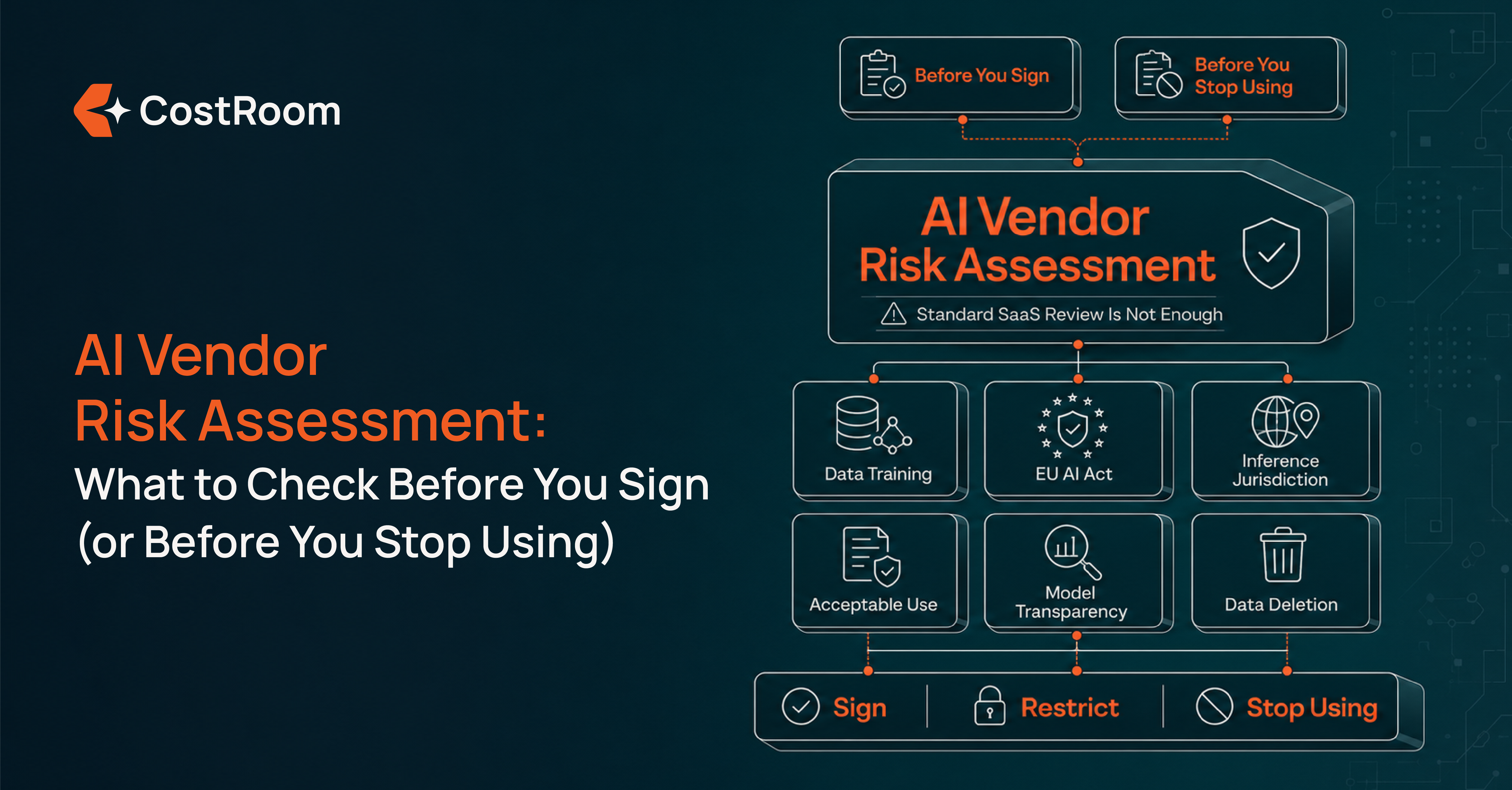
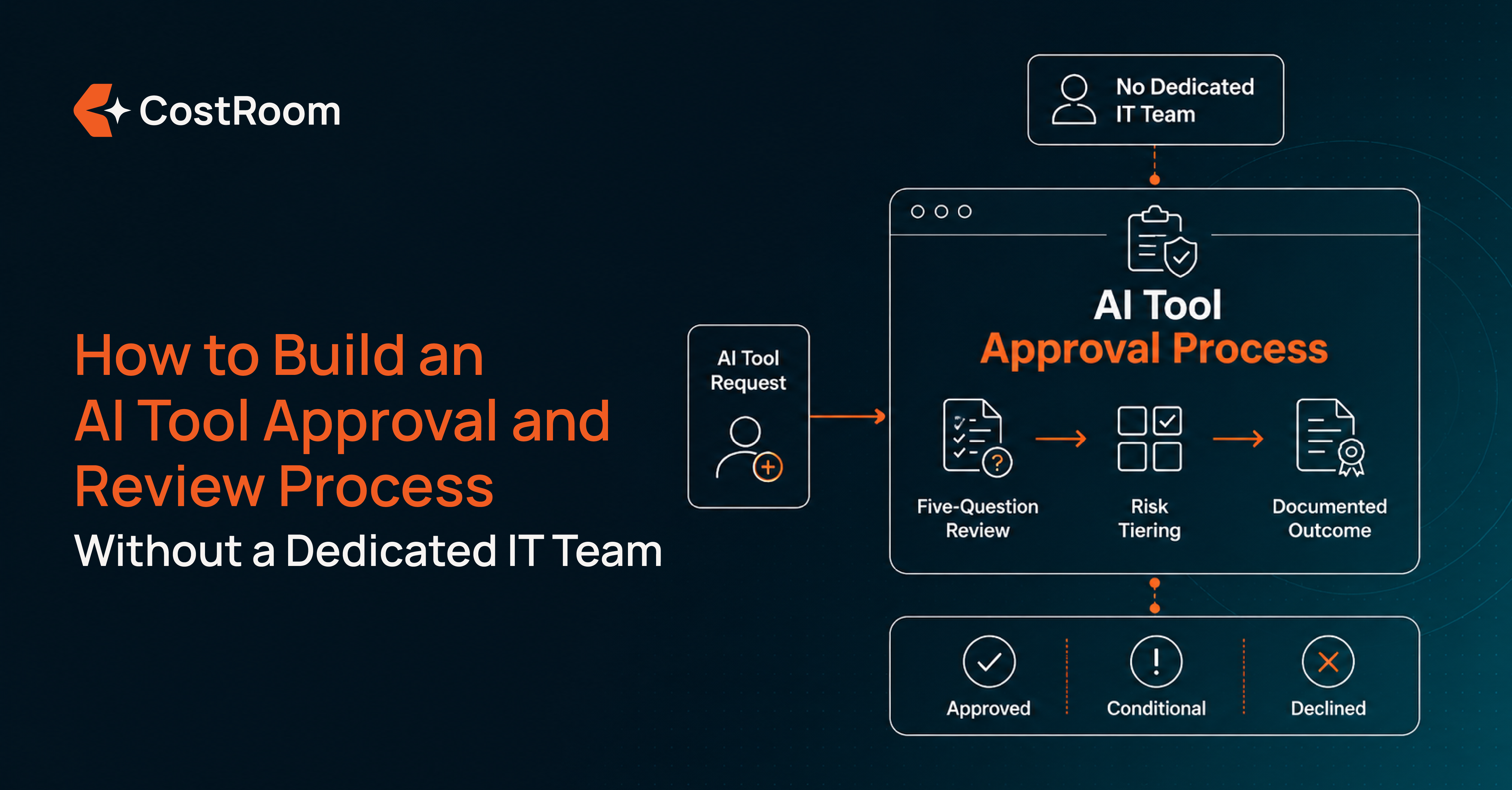
AI. AI tools carry compliance dimensions that SaaS tools typically do not. Acceptable use policies for many AI services restrict how company data can be used to train models or improve products. Data residency requirements for AI processing may conflict with GDPR or other applicable data regulations. And AI tools purchased through expense accounts, without a formal contract or data handling review, create a category of risk that sits entirely outside the standard vendor assessment process. For the full picture of how AI tools are entering company portfolios as uncontracted spend, see Managing AI, SaaS, and Cloud Spend Together: A Guide for Mid-Size Companies.
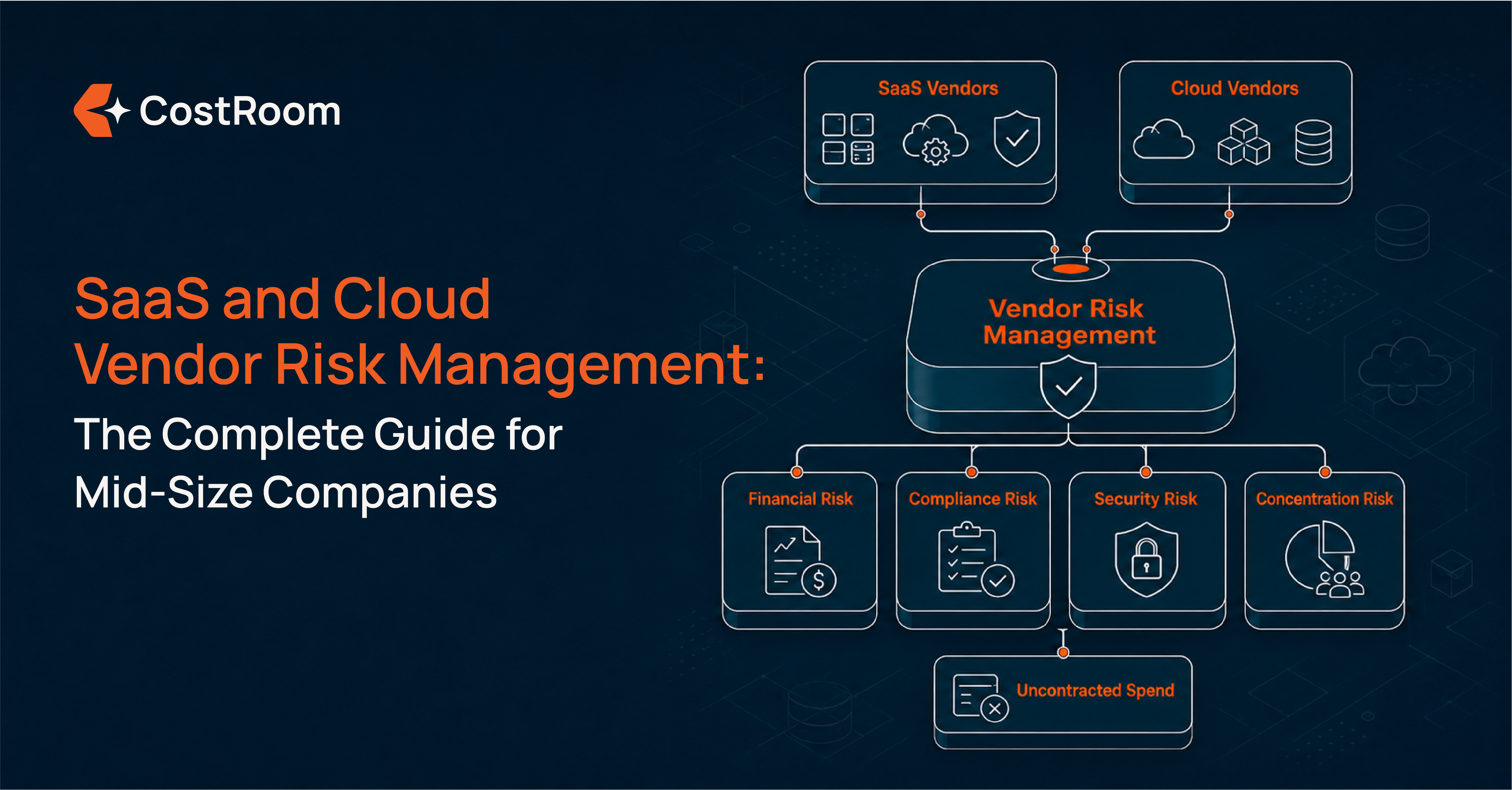
The Four Dimensions of Vendor Risk Mid-Size Companies Carry
Vendor risk conversations in most organisations focus on security. For mid-size companies managing a technology portfolio of $5 million to $20 million per year, the other three dimensions carry equal or greater financial exposure.
Financial risk. Every vendor relationship carries pricing risk. Contracts signed at list price, renewed without benchmarking, or structured around usage tiers that no longer reflect actual consumption represent above-market spend that compounds across renewal cycles. Financial vendor risk is the gap between what the company is paying and what comparable companies at the same scale actually pay. Without benchmarking data, this gap is invisible until a spend review surfaces it.
Compliance risk. GDPR enforcement continues to accelerate, with fines averaging 18 percent higher year-on-year. The EU's Digital Operational Resilience Act began enforcing vendor oversight requirements for financial services firms in January 2025, with direct implications for any mid-size company in that sector or serving clients within it. PCI DSS 4.0 compliance deadlines passed in March 2025. Every SaaS, cloud, and AI vendor that handles regulated data is a potential compliance exposure if its contract terms have not been reviewed against the company's current obligations.
Security risk. The 48 percent third-party breach rate represents an organisation's indirect exposure: the risk that a vendor's own security failure creates a breach affecting the organisation's data. This risk is highest for vendors with privileged access to company systems, customer data, or financial information. It cannot be eliminated, but it can be assessed and prioritised by vendor category, data sensitivity, and contractual liability terms.
Concentration risk. When 92 percent of sampled SaaS vendors share the same infrastructure provider, a company's effective technology vendor risk is concentrated well beyond what the vendor list alone suggests. An organisation managing 286 vendors across SaaS, cloud, and AI, with the majority hosted on the same infrastructure, is less diversified than it appears. Concentration risk assessment maps the infrastructure layer underneath the vendor layer and identifies where a single point of failure has portfolio-wide implications.
Where Uncontracted Spend Sits in the Risk Picture
The vendors that carry the highest unassessed risk are typically the ones that entered the portfolio without a formal procurement review. Tools purchased by individual team members below approval thresholds, AI tools expensed through personal or department accounts, and SaaS subscriptions that were never formally contracted carry no data processing agreement, no security assessment, no exit clause, and no record in the IT or finance system.
The scale of this category is larger than most companies estimate. 55 percent of employees use AI tools that their organisation did not formally approve. The average company has a material gap between its official vendor count and the number of active tools actually processing company data. Every tool in that gap is a vendor risk the organisation is carrying without measuring.
Uncontracted spend is not only a cost recovery problem. It is the category where compliance exposure is most acute, because the absence of a contract means the absence of every protection a contract would normally provide: data handling terms, liability limits, right to audit, and notice obligations in the event of a security incident. For a detailed look at how uncontracted spend accumulates and what categories it comes from, see Why Mid-Size Companies Have More Uncontracted SaaS Spend Than They Think.
What a Vendor Risk Assessment Covers
A vendor risk assessment for a mid-size company covers five components, each of which is necessary to produce an actionable risk picture. Assessing only some of them produces partial visibility and misses the categories where risk is concentrated.
Vendor inventory. You cannot assess what you have not mapped. The first component is a complete, current list of every active vendor across SaaS, cloud, and AI, including tools purchased below the procurement threshold and vendors with API or integration access to company systems. The inventory is not a one-time exercise: it needs to reflect the current state of the portfolio, which changes with every new subscription, team purchase, or contract renewal.
Security posture. For each vendor with access to sensitive data or company systems, the assessment covers security certifications, incident history, data residency and encryption practices, and contractual terms governing notification obligations in the event of a security incident.
Contract compliance. Data processing agreements aligned with applicable regulations, liability terms, exit clauses that specify what happens to data upon termination, and auto-renewal provisions that lock in contract terms without a compliance review. Many mid-size companies have signed contracts that contain data processing terms that predate current GDPR requirements. Without a contract compliance review, the gap is invisible.
Financial risk. Current pricing benchmarked against market rates. Contracts where pricing has not been challenged since initial signature, or where usage has declined below the contracted tier, are carrying above-market spend that a renewal-triggered renegotiation can address. For how vendor benchmarking and negotiation work in practice, see How to Negotiate SaaS and Cloud Vendor Contracts: A Guide for Mid-Size Companies.
Compliance alignment. Data categories handled by each vendor assessed against applicable regulations: GDPR for EU personal data, HIPAA for healthcare data, PCI DSS for payment card data, and sector-specific requirements where applicable. For a detailed breakdown of what a vendor risk assessment covers and how to structure one, see What Is a SaaS Vendor Risk Assessment and How Does It Work?.
Map Your Vendor Risk Before It Maps You
CostRoom runs the vendor inventory and risk assessment for you: every active SaaS, Cloud, and AI tool mapped, benchmarked, and assessed before a breach or audit surfaces what you did not know was there.
The Software Audit Dimension
Software vendor audits represent the financial crystallisation of unmanaged vendor risk. When a vendor believes a company is using more licences than it has contracted, or using a product in ways that fall outside the original agreement terms, an audit converts what was a theoretical compliance risk into a direct billing event. The cost is not only the audit itself: licence true-ups, back-billing for out-of-compliance usage, and legal fees frequently reach seven figures.
According to Flexera's 2026 State of ITAM Report, 48 percent of organisations were audited by at least one software vendor in the past 12 months. 44 percent spent more than $1 million on software audits over the previous three years. These are not outcomes limited to large enterprises: mid-size companies are audit targets when vendors identify usage patterns that suggest under-licensing or scope violations.
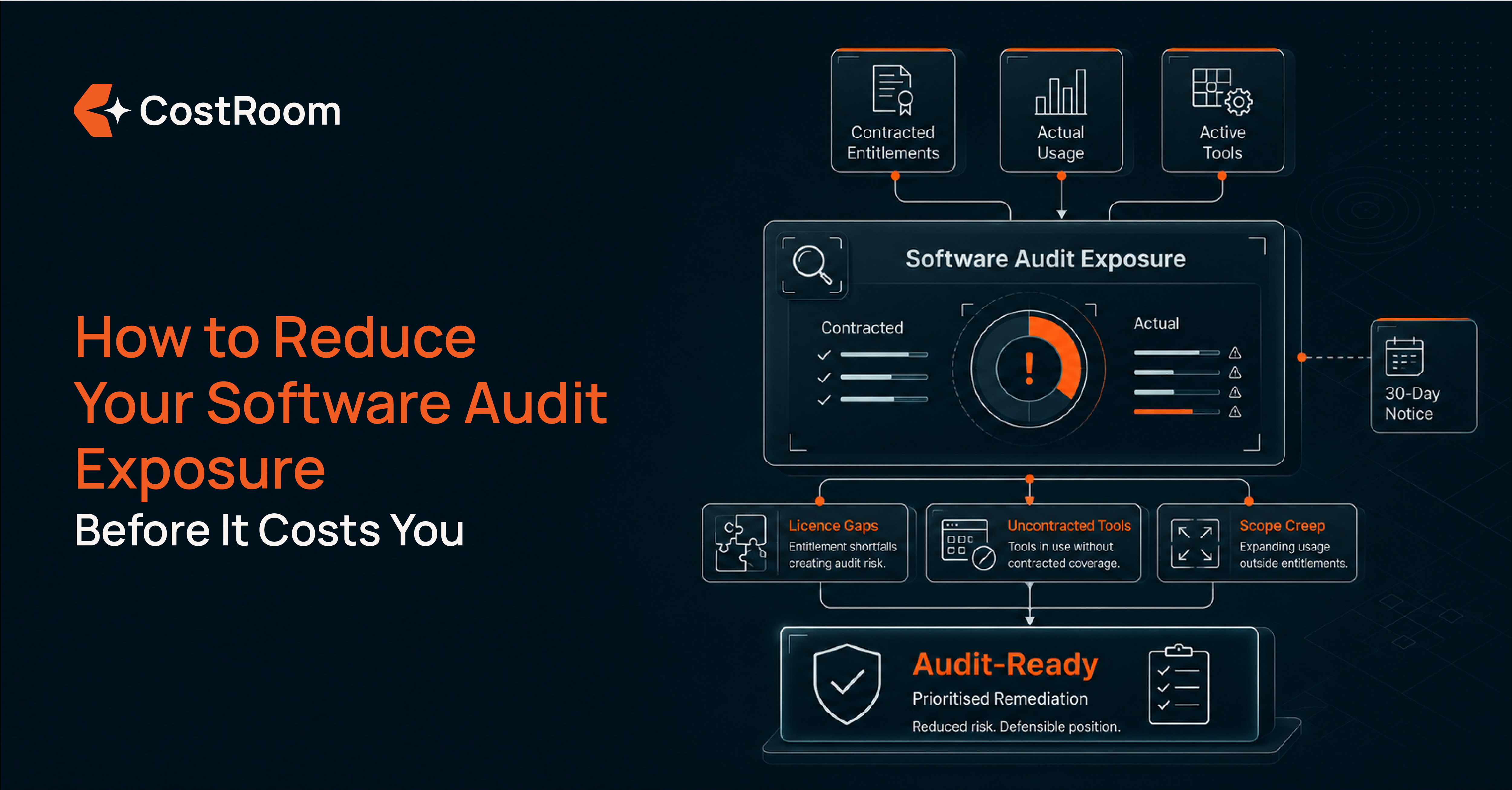
The most effective way to manage audit risk is not to prepare for audits: it is to maintain the kind of accurate, current vendor inventory and contract compliance picture that removes the conditions that trigger them. A company that knows what it has contracted, at what usage tier, with what permitted deployment scope, and that reviews this before each renewal, is in a materially different position than one that does not. For a practical guide to reducing audit exposure before it becomes an audit bill, see How to Reduce Your Software Audit Exposure Before It Costs You.
How Mid-Size Companies Manage Vendor Risk Without a Dedicated Team
The enterprise approach to vendor risk management assumes dedicated analysts, continuous monitoring tooling, and an annual assessment cycle across every vendor in the portfolio. At mid-size scale, that investment is disproportionate. The gap it leaves is not theoretical: it is the same gap that produces the 48 percent third-party breach rate and the $4.91 million average breach cost.
A vendor-agnostic optimisation layer provides the vendor risk management capability that mid-size companies need without the headcount requirement. It carries no commercial relationships with vendors and holds no OEM agreements, so its assessments reflect only client data and current market conditions.
In practice, the engagement covers four areas.
The vendor inventory is the entry point, covering every active SaaS, cloud, and AI tool in the portfolio, including uncontracted tools that have entered below the procurement threshold. This is the Inform phase equivalent for vendor risk: you cannot manage what you have not mapped.
Financial risk is assessed through market benchmarking across 100+ vendors simultaneously. Above-market contracts are identified and flagged for renegotiation before the next renewal. New tools entering the portfolio are sourced at structured rates rather than at list price, removing the above-market baseline problem before it compounds.
Compliance risk is assessed through contract review across the portfolio, with data processing agreements checked against current regulatory obligations. AI tools are assessed for acceptable use constraints and data residency requirements as part of the same review, not as a separate exercise months later.
Renewal management provides the ongoing structure that prevents vendor risk from re-accumulating: every upcoming renewal surfaces 90 days in advance, with pricing benchmarked against current market rates before it executes.
The practical distinction from a FinOps tool matters here. A tool surfaces data. A vendor-agnostic optimisation layer acts on it: running assessments, managing renewals, benchmarking pricing, and sourcing new tools at rates that remove the conditions that produce both above-market spend and audit exposure simultaneously.
For the foundational guide to how spend optimisation and FinOps principles apply at mid-size scale, see FinOps for Mid-Size Companies: Managing SaaS, Cloud, and AI Spend. For the complete framework for managing SaaS and cloud spend optimisation across the full portfolio, see SaaS and Cloud Spend Optimisation: The Complete Guide for Mid-Size Companies.
See Your Full Vendor Risk Picture
CostRoom maps every active SaaS, Cloud, and AI vendor, benchmarks pricing against market rates, and assesses compliance and audit exposure across your full portfolio.
Frequently Asked Questions
What is SaaS vendor risk management?
SaaS vendor risk management is the discipline of identifying, assessing, and reducing the risk carried by every SaaS subscription, cloud provider, and AI tool in a company's portfolio. It covers four dimensions: financial risk (above-market pricing, renewal lock-in), compliance risk (data processing agreements, regulatory alignment), security risk (third-party breach exposure), and concentration risk (infrastructure dependency across the portfolio). In 2026, it necessarily includes AI tools alongside SaaS and cloud, as AI tools carry distinct compliance and data handling obligations that standard SaaS assessments do not address.
What are the biggest vendor risks for mid-size companies in 2026?
The three most acute vendor risks for mid-size companies in 2026 are third-party breaches (48 percent of confirmed breaches involve a third party, according to the Verizon 2026 Data Breach Investigations Report), AI tool compliance exposure (55 percent of employees use AI tools that were not formally approved, according to Flexera 2026), and software audit cost (48 percent of organisations were audited in the past 12 months, with 44 percent spending over $1 million on audits in three years). All three stem from the same root cause: an incomplete, unassessed vendor portfolio.
Why has third-party risk increased so significantly?
Third-party breach rates rose from 30 percent to 48 percent of confirmed breaches in a single year, according to the Verizon 2026 Data Breach Investigations Report. The increase reflects two parallel trends: the growing number of vendors in the average company portfolio (now 286 per company), and the expansion of vendor access to sensitive data as SaaS and AI tools process more business-critical information. Each additional vendor without a formal security and compliance review adds to the third-party breach surface area.
How does uncontracted spend create vendor risk?
A tool purchased below the procurement threshold, expensed without a formal contract, or adopted by an individual team member without IT or legal review carries no data processing agreement, no security assessment, no liability terms, and no exit clause. If a vendor incident affects data processed by an uncontracted tool, the company has no contractual protections, no pre-agreed notification obligations, and often no record that the vendor had access to company data at all. Uncontracted spend is not only a cost recovery problem: it is the category where compliance exposure is least visible and most acute.
How does a mid-size company manage vendor risk without a dedicated team?
A vendor-agnostic optimisation layer provides the vendor risk management capability that mid-size companies need without the headcount investment of a dedicated internal function. It runs the vendor inventory as the entry point, covering every active SaaS, cloud, and AI tool including uncontracted tools. It assesses financial risk through market benchmarking, compliance risk through contract review, and security risk by flagging tools that lack standard certifications or carry data handling terms that conflict with applicable regulations. Renewal management runs continuously, so vendor risk does not re-accumulate between reviews.