The finance team receives a SaaS invoice 18% higher than last year. Nobody approved the increase. Nobody flagged the renewal. The vendor applied the price escalation clause written into the original contract, the notice window closed without anyone initiating a conversation, and the contract renewed automatically.
This is not vendor dishonesty. The price increase was in the terms. The terms renewed. The company paid.
What makes this pattern so persistent is that it is entirely structural. At a mid-size company managing 20-30 SaaS and cloud contract renewals every quarter, the conditions that produce this outcome repeat every few months, across different tools, for the same underlying reason: renewal management is reactive, and reactive renewal management is a guaranteed way to pay the vendor's preferred rate.
This post explains how the auto-renewal trap works, why it hits mid-size companies harder than most, and what specifically changes when the renewal process becomes proactive. For the full framework on managing renewals across a SaaS and cloud portfolio, see the complete guide to renewal management.
How Auto-Renewal Became the Default
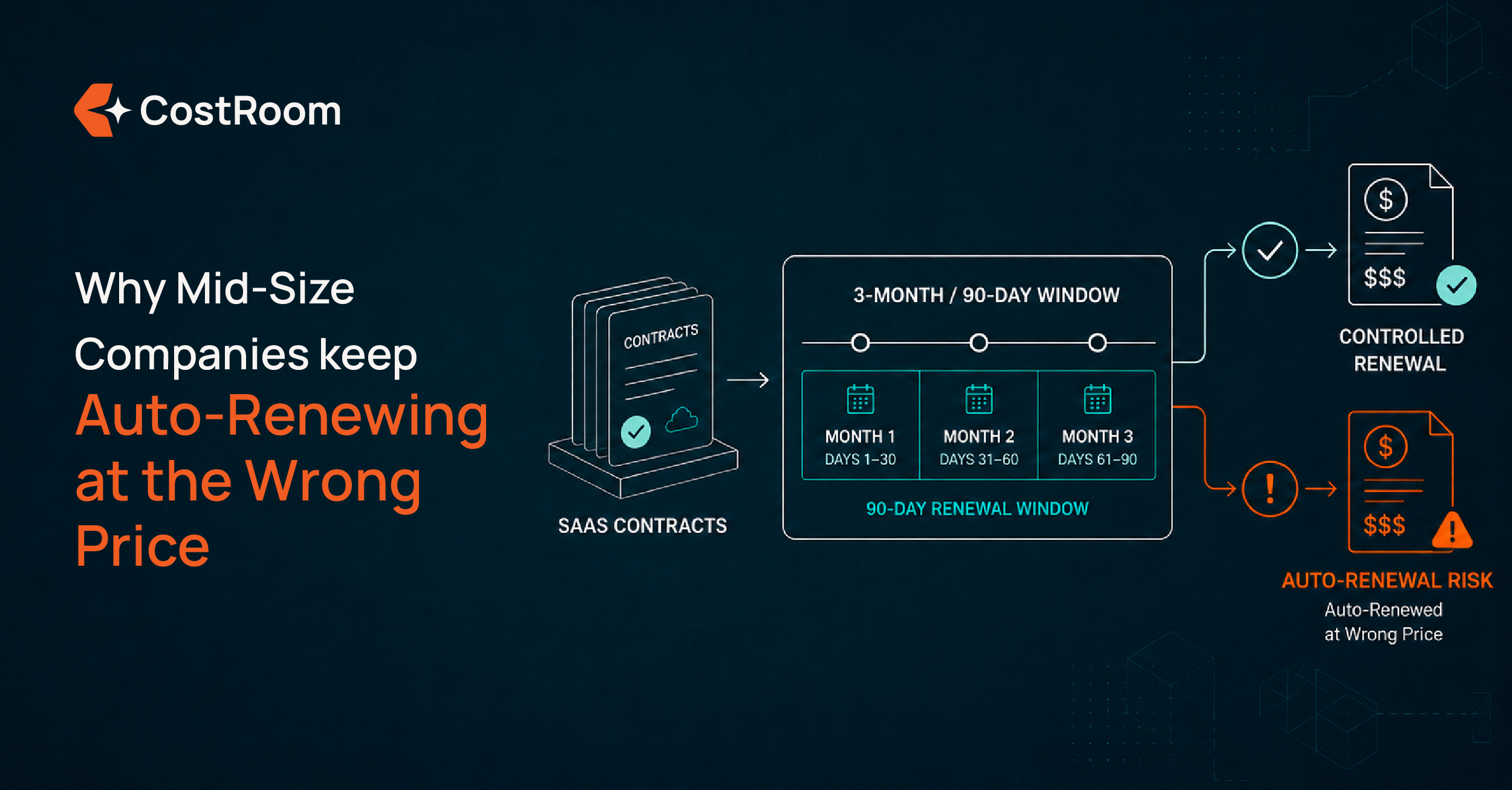
Auto-renewal clauses are standard in SaaS contracts because they serve the vendor's commercial interest. They convert a decision, renew or not renew, into a non-decision: if the customer takes no action before the notice period closes, the contract rolls over at the vendor's preferred terms.
The clause is not buried. It is in the contract that was signed 12 to 24 months ago, which rarely gets re-read at renewal time. The notice period, typically 60 to 90 days before the renewal date, is designed to close before most internal review processes get started. The vendor does not need to do anything. The structure of the contract does the work.
For a company managing five or ten SaaS tools, disciplined tracking is feasible. At 100+ tools with 20-30 contracts renewing every quarter, the probability that some of those renewals pass through the notice window without any meaningful review is near-certain. The volume alone creates the gap.
What "At the Wrong Price" Actually Means
The phrase covers two separate problems. They tend to travel together, but they are not the same issue.
Price escalation by default. Most SaaS contracts include a price escalation clause, typically expressed as a fixed annual percentage increase, that activates at renewal unless the customer negotiates. If no one initiates a conversation before the renewal window closes, the price goes up. If the market rate for the same service has moved sideways or down since the last renewal, the escalation still applies. The company is paying more for the same thing, and no one has tested whether that rate is defensible against what comparable companies actually pay.
Licence count mismatch. Renewals lock in the current licence count for the next term. A company that contracted for 80 licences a year ago and is actively using 55 will renew at 80 if no one reviews utilisation before the renewal is confirmed. The 25 unused licences represent overspend that will run for the full term of the renewal. Licence right-sizing requires someone to pull the utilisation data and initiate a conversation with the vendor, which is exactly the kind of work that does not happen when renewals are caught at the last minute.
Both problems are avoidable. Both require advance engagement to fix.
The Three Auto-Renewal Traps Mid-Size Companies Fall Into
Trap 1: Tracking the renewal date, not the notice period. The renewal date might be on the calendar. The notice period end date is rarely there alongside it. A contract with a 90-day notice period closes its negotiation window 90 days before the renewal, not on the renewal date itself. A team that spots a renewal approaching 45 days out has already missed the window. The contract will auto-renew regardless of what happens next.
This is probably the most common version of the problem. The date is visible; the clock that controls leverage is not.
Trap 2: The escalation clause in the renewal notice. Some vendors send a renewal notice 30 to 60 days before the renewal date, which includes the pricing for the upcoming term. The communication is functional, but easy to miss in a busy inbox, and easy to mistake for a routine update rather than a price commitment in progress. If the IT or finance team does not catch it and respond, the higher pricing is treated as accepted by default.
Trap 3: Multi-year lock-in at the wrong moment. Vendors frequently offer a discount at renewal in exchange for a longer commitment, typically two or three years. The discount looks attractive in the moment. The lock-in removes the company's ability to renegotiate, right-size, or exit the contract for the full duration of the new term, regardless of whether the tool continues to deliver value or whether market pricing shifts. This trade is worth making from a position of full information. It is rarely the right trade when made under time pressure at 30 days before renewal, with no alternatives evaluated and no benchmark in hand.
Why the Problem Compounds Across 20-30 Contracts Per Quarter
One missed renewal is a line item. Twenty missed renewals per quarter, each compounding its own escalation clause into the following year's baseline, is a structural overspend across the technology budget.
At a mid-size company, SaaS and cloud contract renewals are not occasional events. They are a continuous background process, running on different cycles across different vendors and different tools, with no single owner watching the full calendar. Earlier this year, a company in the manufacturing segment audited its renewal process and found that fewer than a third of its quarterly renewals had been actively engaged before the notice window closed. The remainder had auto-renewed at the vendor's preferred terms, some with escalation clauses in effect, some at licence counts that no longer reflected actual usage.
The total cost of passive renewal management is not visible on any single invoice. It accumulates across every price escalation that went unchallenged, every licence count that went unreviewed, and every multi-year lock-in that removed the flexibility to adapt. Across a full year of renewals, that figure is material.
For the broader context on how reactive procurement across both SaaS and cloud creates compounding costs, see SaaS and Cloud Spend Optimization: The Complete Guide.
The Role of Timing: Why the Window Matters More Than the Negotiation
The leverage in a contract renewal depends entirely on when the conversation starts.
At 90 days before renewal, the company has time to run a pricing benchmark, evaluate whether the contracted scope matches current usage, and engage the vendor with genuine alternatives. The vendor, at that stage, is still in a competitive position: the customer has enough time to evaluate other options if the conversation does not go well. That time pressure is real, and it shifts the negotiation.
At 30 days, the dynamics reverse. There is not enough time to run a competitive evaluation. The vendor knows it, and the negotiation reflects it. The conversation at 30 days is often a formality. The outcome tends to be whatever the vendor proposed in the renewal notice.
Structured renewal management does not change what happens in the negotiation itself. It changes when the negotiation starts, which determines who has the leverage when it happens. CostRoom's Renewal Management approach is built around this window: every contract in the portfolio gets flagged at the 90-day mark, with pricing benchmarks, not at the 30-day mark when leverage has already passed.
What Changes When Renewals Are Managed Proactively
When every renewal is engaged at 90 days with market pricing data in hand, the dynamic shifts on both sides of the conversation.
Vendors priced above market receive a structured discussion with data they cannot easily dismiss. Vendors priced competitively get confirmed and renewed efficiently, without the internal overhead of a scramble. The company spends less time on emergency renewal management and more time on deliberate vendor decisions.
The compounding benefit is visibility. A company that manages renewals proactively holds a forward-looking calendar of every upcoming commitment, which makes resource planning and budget forecasting materially more reliable. Renewals stop being surprises and become scheduled decisions. For a detailed look at what a structured renewal management system covers and whether your company needs one, see What Is a SaaS Renewal Management System and Do You Need One?.
Map Your Renewals Before the Window Closes
A spend analysis surfaces every upcoming renewal, notice period, and above-market pricing gap before the next renewal cycle starts.
Frequently Asked Questions
Why do SaaS contracts auto-renew at higher prices? Most SaaS contracts include a price escalation clause that activates automatically at renewal unless the customer initiates a negotiation before the notice period closes. The notice period, typically 60 to 90 days before the renewal date, is designed to close before most companies have had time to run a pricing benchmark or evaluate alternatives. If no one engages the vendor in advance, the escalation applies by default and the contract renews at the higher rate.
What is the cost of missing a SaaS renewal window? Missing a SaaS renewal window has two direct financial consequences. The first is price escalation: the contract renews at the vendor's preferred rate, including any annual price increase written into the original terms, without any negotiation. The second is licence count lock-in: the renewal confirms the current contracted licence count for the next term, regardless of whether actual usage has changed. Both costs run for the full term of the new contract.
How do vendors use auto-renewal clauses against companies? Auto-renewal clauses convert a deliberate purchasing decision into a default outcome. If the customer takes no action before the notice period ends, the contract renews at the vendor's preferred terms. Vendors rely on the fact that mid-size companies managing 20-30 renewals per quarter will not catch every one before the notice window closes. The clause itself is disclosed in the contract; the mechanism that makes it costly is the volume of renewals and the absence of a structured process to track each notice period.
Why do mid-size companies overpay on SaaS renewals? Mid-size companies overpay on SaaS renewals primarily because renewal management is reactive rather than proactive. With 20-30 contracts renewing every quarter, the combination of auto-renewal clauses, price escalation terms, and short notice periods means that any gap in the renewal tracking process results in contracts renewing at the vendor's preferred rate. The companies that consistently pay below-market rates on renewals are the ones that engage vendors at 90 days, with market benchmarks, rather than catching renewals at 30 days or after the fact.
What is the difference between a renewal date and a notice period? A renewal date is when the contract formally renews or expires. A notice period is the window before that date within which the customer must signal an intent to renegotiate, right-size, or exit the contract. Most SaaS contracts require 60 to 90 days notice. If the notice period closes without any action, the contract auto-renews at existing terms regardless of what happens afterward. Managing renewals effectively means tracking both dates, not just the renewal date.