Most mid-size companies enter budget planning without a current, verified picture of what they are spending on technology. Numbers come from last year's invoices, estimates from IT, and a SaaS line item in the finance system that has not been reconciled against active contracts in twelve months. Budgets get set against incomplete information, and the gap between what the company thinks it spends and what it actually spends tends to be larger than anyone expects.
A technology spend review closes that gap before the budget conversation happens rather than after. Done four to six weeks before annual planning begins, it gives finance and IT accurate, benchmark-grounded numbers to work with, not estimates to defend.
This guide covers what a technology spend review is, what it includes, how to run one, and what it produces.
What Is a Technology Spend Review?
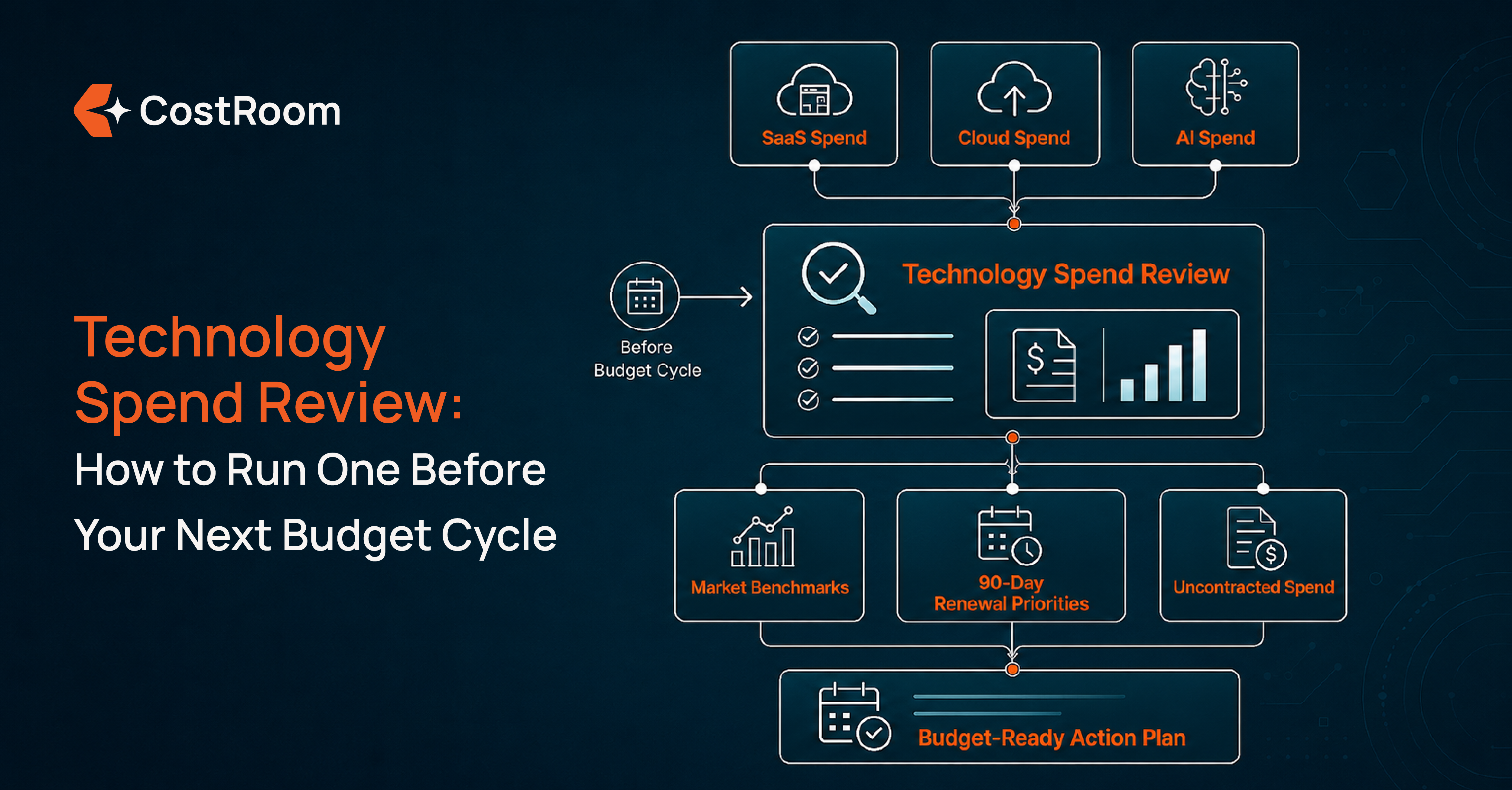
A technology spend review is a structured audit of every active SaaS subscription, cloud commitment, and AI tool in a company's portfolio, mapped against current market pricing, renewal dates, compliance status, and optimisation opportunity. The output is a prioritised action plan, not a report that gets filed.
The distinction from a standard IT audit matters. An IT audit assesses whether systems are operating, whether security controls are in place, and whether software is appropriately licensed. A technology spend review addresses the financial layer: what the company is currently paying for each tool, whether that price reflects current market rates, when each contract renews, and where the largest savings opportunities sit in the next 90 days. The two reviews are complementary; they address different questions.
For the foundational context on how spend visibility connects to the broader FinOps maturity framework, see FinOps for Mid-Size Companies: Managing SaaS, Cloud, and AI Spend.
When to Run a Technology Spend Review
The most common trigger is the annual budget cycle. A technology spend review completed before budget planning gives the CFO and IT Director verified technology spend figures, a full renewal list for the next 12 months, and a prioritised view of where costs can be reduced before next year's numbers are set.
Four other triggers are common at mid-size companies. A major SaaS or cloud contract approaching renewal without a prior benchmark. A cost spike on a recent invoice that cannot be attributed to a specific change. An accelerating accumulation of AI subscriptions, often purchased below procurement approval thresholds, with no current count of what is active. A leadership change at CFO or IT Director level, where the incoming person wants a verified baseline before making budget commitments.
In all four cases, the logic is the same: spend review before decisions, not after.
What a Technology Spend Review Covers
A technology spend review covers three spend categories that require distinct review approaches but need to be mapped together to produce a complete picture.
SaaS. Every active subscription across the full company, including tools purchased by individual departments below the standard procurement approval threshold. The review maps licence counts, current pricing relative to market benchmarks, utilisation data where available, renewal dates, and auto-renewal clauses. Uncontracted spend in the SaaS category, tools that are active but were never formally contracted, is typically the largest discovery at this stage.
Cloud. Committed spend across all cloud providers, including reserved instance coverage, right-sizing gaps between provisioned and actual usage, and enterprise agreement terms approaching renewal. Cloud spend often appears stable in a consolidated invoice view while masking material over-provisioning at the resource level.
AI. Active AI subscriptions and API-based tools across the portfolio, including tools that entered through expense accounts without a formal contract. AI tools carry compliance dimensions that SaaS tools typically do not: data handling requirements and acceptable use constraints that create regulatory exposure the longer they run unreviewed.
For the complete picture of how these three categories interact and why managing them separately produces an incomplete view, see FinOps Maturity Stages for Mid-Size Companies: Inform, Optimise, Operate.
Ready to See What Your Technology Spend Review Would Surface?
CostRoom runs the spend review for you: every active SaaS, Cloud, and AI tool mapped, benchmarked, and prioritised for optimisation before your next budget cycle.
How to Prepare: What You Need Before the Review Starts
The preparation stage surfaces more information than most mid-size finance teams expect to have to assemble. Four categories of data are required before the review work can begin.
A consolidated vendor list. Most companies have this spread across three sources: the finance system (SaaS tools on direct invoice), the IT system (tools managed through device management or similar platforms), and expense management (tools purchased by individuals or departments below approval thresholds). None is complete on its own. The full list requires reconciling all three.
Contract copies or renewal date records. For each vendor identified, the contract or at minimum the renewal date and notice period. The renewal window, typically 30 to 90 days before the renewal date, is the only point in the contract lifecycle where pricing can be renegotiated before terms lock in automatically.
Current billing exports from cloud providers. Not the consolidated invoice, but the line-item billing data that shows how committed spend breaks down across services, regions, and resource types.
Recent expense reports. Specifically for AI tools and SaaS tools that may have been purchased by individual team members in the last six to twelve months. These are the most likely sources of uncontracted spend in the current portfolio.
The preparation stage alone tends to surface tools that finance and IT did not know were active. That discovery is a feature of the process, not an anomaly.
What the Review Produces
The output of a technology spend review is a prioritised action plan structured around decisions that can be acted on immediately.
A 90-day renewal priority list. Every contract renewing in the next 90 days, ranked by optimisation opportunity. Contracts where benchmarking shows above-market pricing, where licence counts are misaligned with current usage, or where auto-renewal will lock in terms without review sit at the top. For guidance on how to structure the renewal management process that follows the review, see SaaS and Cloud Contract Renewal Management: The Complete Guide for Mid-Size Companies.
A benchmarked pricing view across the portfolio. Each active contract compared to what comparable companies at the same scale and usage volume are currently paying. Above-market contracts are flagged for renegotiation before the next renewal executes.
An AI compliance flag list. Active AI tools assessed against their data handling requirements and acceptable use terms. Tools processing sensitive business data without a reviewed contract are prioritised for immediate action, regardless of their cost profile.
A right-sizing analysis. Licences and cloud resources where contracted usage materially exceeds current consumption. Right-sizing removes the waste layer; it does not address whether the underlying pricing is at market rate, which is why it is addressed alongside benchmarking rather than instead of it.
An uncontracted spend summary. Tools that are active and generating cost but that have no formal contract on record. These are the highest-priority items for the sourcing process that follows the review.
For the complete spend optimisation framework that the review feeds into, see SaaS and Cloud Spend Optimisation: The Complete Guide for Mid-Size Companies.
Running the Review Without an Internal FinOps Team
Most mid-size companies do not have a FinOps practitioner, a dedicated IT finance analyst, or a procurement team with current market rate data across SaaS, cloud, and AI simultaneously. Running the spend review in-house typically requires pulling the CFO, IT Director, and finance operations into a process that takes several weeks and produces a partial picture, because current market benchmarks are not available internally.
What stalls the in-house review most often is not effort: it is the absence of market rate data. What the company currently pays for a given tool is visible in the contract. Whether that price is at, above, or below what comparable companies currently pay requires vendor benchmarking data that is not publicly accessible and is not held by any single company.
A vendor-agnostic optimisation layer runs the review with the data that makes it actionable: current market benchmarks across 100+ SaaS, Cloud, and AI vendors, the vendor relationships that translate benchmarking into negotiation outcomes, and the compliance assessment capability to flag AI tools against applicable regulatory and contractual constraints.
The practical difference is in what the output enables. An in-house review produces a list of what the company is spending. An expert-led review produces a benchmark-grounded action plan with specific renegotiation targets, renewal dates where leverage exists, and new sourcing opportunities to prevent above-market pricing from compounding across future renewal cycles. To see what the review looks like as an engagement starting point, see the Spend Analysis and Optimisation overview.
Run Your Technology Spend Review Before the Next Budget Cycle
CostRoom maps every active SaaS, Cloud, and AI tool, benchmarks pricing against current market rates, and delivers a prioritised action plan with 90-day renewal priorities.
Frequently Asked Questions
What does a technology spend review cover?
A technology spend review covers every active SaaS subscription, cloud commitment, and AI tool in a company's portfolio, assessed for current pricing relative to market benchmarks, renewal dates and notice periods, licence utilisation, compliance status for AI tools, and uncontracted spend accumulating below procurement review thresholds. The output is a prioritised action plan for the next 90 days of renewal and renegotiation activity.
How often should a mid-size company run a technology spend review?
For most mid-size companies, a full technology spend review once per year, completed four to six weeks before annual budget planning, is the right cadence. Between full reviews, the renewal calendar surfaced by the review provides the mechanism for reviewing individual contracts before they auto-renew. A supplementary review is warranted when AI tool adoption has accelerated significantly, when a major contract is approaching renewal without a prior benchmark, or when a cost spike has appeared without explanation.
What is the difference between a technology spend review and an IT audit?
An IT audit assesses whether systems are operating correctly, security controls are in place, and software is appropriately licensed. A technology spend review addresses the financial layer: what the company is currently paying for each tool, whether that pricing is at or above current market benchmarks, when each contract renews, and where the largest savings opportunities sit in the near term. The two exercises address different questions and both have value.
How long does a technology spend review take?
The timeline depends on how complete and accessible the company's vendor and contract records are. When relevant data is centralised, an expert-led review of a typical mid-size portfolio covering 50 to 150 active tools across SaaS, cloud, and AI typically produces an action plan within two to three weeks of the data-gathering stage completing. When data is spread across finance, IT, and expense systems and needs to be consolidated first, the preparation stage extends the overall timeline.