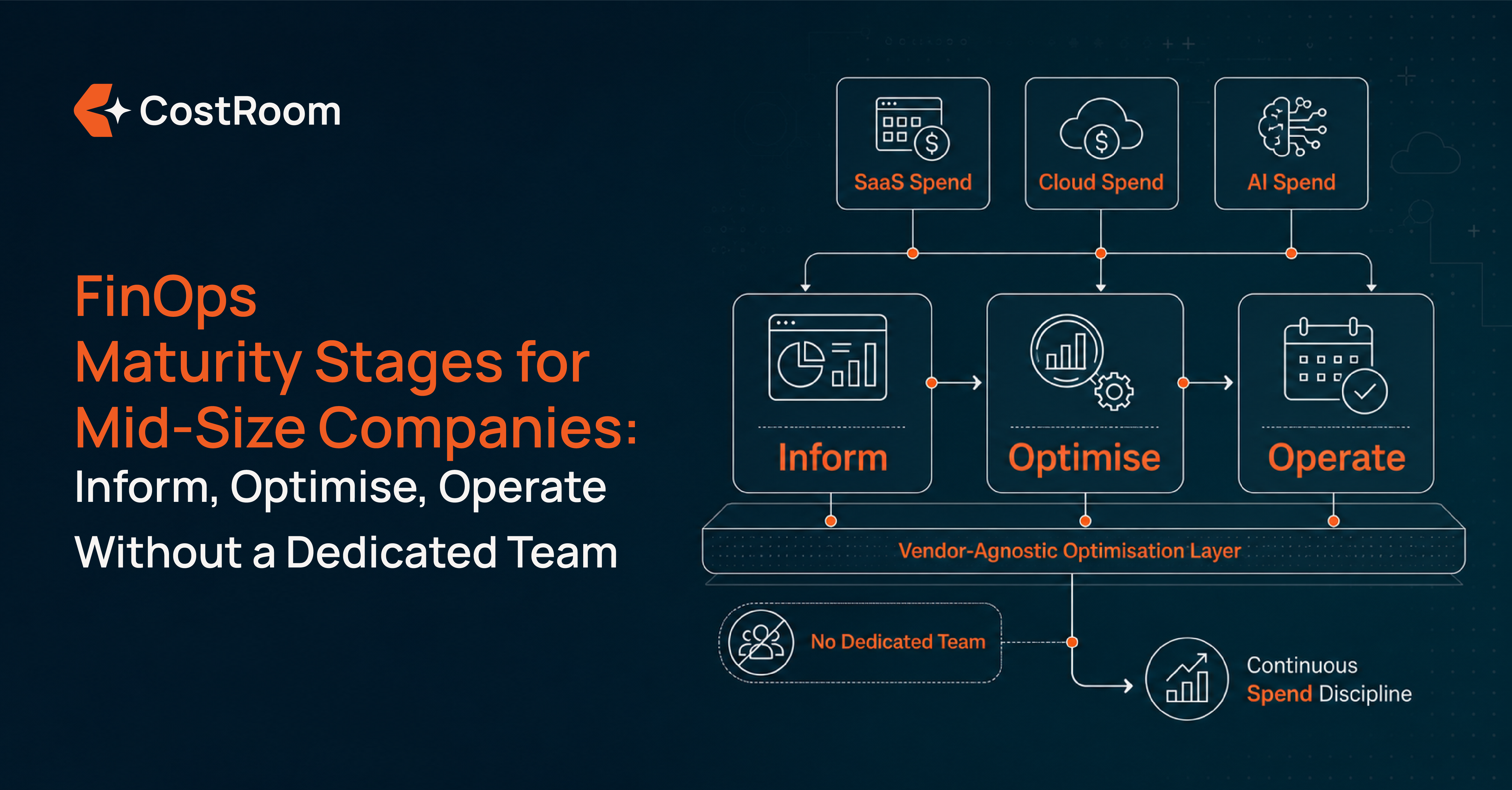
The FinOps Foundation describes financial discipline for technology spend as a maturity arc, not a single project. Organisations do not implement FinOps once and finish; they move through three successive stages, each building on the visibility and capability established by the previous one. Understanding where your organisation sits in that arc, and what each stage actually requires to complete, is a more useful starting point than asking whether to adopt FinOps at all.
For mid-size companies without dedicated FinOps practitioners, the stages look different in practice than the enterprise model assumes. This guide explains what each stage means, what it takes to progress through each one, and how mid-size companies reach the same outcomes through a different path.
What Are the FinOps Maturity Stages?
The FinOps Foundation defines three maturity stages: Inform (building visibility into what the organisation is spending and where), Optimise (eliminating waste and aligning contracts to actual usage), and Operate (embedding cost discipline as a continuous practice rather than a periodic project). Each stage builds on the one before it. Visibility enables optimisation; optimisation sustained over time becomes operational discipline.
The three stages apply across all technology spend categories. In 2026, that means SaaS, cloud, and AI together, not cloud alone. For the foundational context on how FinOps has expanded beyond its cloud origins, see What Is FinOps? A Plain-English Guide for Mid-Size Company Finance Teams.
Stage 1, Inform: Building a Complete Spend Picture
The Inform stage is complete when the organisation has a single, current view of all technology spend across SaaS, cloud, and AI, including pricing relative to market benchmarks, renewal dates, auto-renewal clauses, and compliance flags for tools handling sensitive data. Most mid-size companies beginning this stage discover that their total technology spend is materially higher than any prior estimate.
What the Inform stage produces in practice:
Every active tool and commitment mapped. SaaS subscriptions across all departments, including tools purchased by individual teams below approval thresholds. Cloud commitments across all providers. AI tools that have entered the portfolio through expense accounts or team-level purchases without a formal contract. Uncontracted spend that has been accumulating outside standard procurement processes is typically the largest single discovery at this stage.
Current pricing benchmarked against market rates. Not against vendor list price or last year's renewal figure, but against what comparable companies at the same scale and volume are actually paying today. Without this benchmark, it is not possible to know whether any given contract represents good value or above-market spend.
Renewal dates and notice periods catalogued. Every contract has a renewal date. Most have auto-renewal clauses that lock in terms without review if notice is not given within a specified window. The Inform stage maps all of them before any optimisation work begins.
The Inform stage does not produce savings on its own. It produces the complete picture from which all subsequent decisions are made. Starting the Optimise stage without completing Inform is the operational equivalent of renegotiating without knowing your current position.
Stage 2, Optimise: Acting on What the Analysis Reveals
Optimise covers three distinct actions: right-sizing (aligning contracted licences and committed resources to actual usage), vendor renegotiation (using market benchmarks to bring pricing down from above-market baselines), and sourcing (ensuring new tools enter the portfolio at structured market rates rather than at list price). All three are required; none is sufficient on its own.
Right-sizing addresses the gap between what the company is contracted to use and what it actually uses. Unused SaaS licences, over-provisioned cloud resources, and AI subscriptions not adopted at the contracted usage level are all recoverable spend. Right-sizing removes the waste layer.
Vendor renegotiation addresses the pricing layer that right-sizing does not touch. A licence count correctly aligned to usage at a price that was never benchmarked still leaves the company paying above the market rate. Renegotiation requires knowing what comparable companies pay, carrying that data into the renewal conversation, and using the leverage that an approaching renewal creates. For how vendor negotiation works across SaaS and cloud contracts, see How to Negotiate SaaS and Cloud Vendor Contracts: A Guide for Mid-Size Companies.
Sourcing prevents the above-market baseline problem from recurring with each new tool. Every new contract entered at list price becomes the starting point for every future renewal at that vendor. A sourcing process that uses established vendor relationships and current market rate data means new contracts start at structured pricing, not at whatever the vendor's opening position happens to be.
Where Does Your Portfolio Sit Across These Stages?
CostRoom maps your SaaS, Cloud, and AI spend and identifies exactly what each optimisation stage looks like for your specific portfolio.
Stage 3, Operate: Making Optimisation a Continuous Practice
Operate means the renewal calendar, benchmarking process, and vendor risk framework are running continuously rather than as annual projects. Every upcoming renewal surfaces 90 days in advance of the notice window. Pricing is reviewed against current market rates before each renewal executes, not after it locks in for another year. AI tools are assessed for compliance alongside SaaS and cloud, not in a separate process months later.
The Operate stage is where the discipline becomes self-sustaining rather than project-dependent. For mid-size companies, reaching this stage requires a structured renewal management process that covers the full portfolio across all three spend categories. For how ongoing renewal management works in practice, see SaaS and Cloud Contract Renewal Management: The Complete Guide for Mid-Size Companies.
The gap between completing Optimise and reaching Operate is where most mid-size companies stall. The Optimise stage produces visible results: savings identified, pricing improved, waste removed. The work can feel done. Operate requires maintaining the structures that keep it done, and that maintenance requires ongoing capacity that most mid-size finance and IT teams do not have available.
Where Mid-Size Companies Typically Start in the Maturity Model
Most mid-size companies beginning this process are in the early Inform stage, often without realising it. They have some visibility into some of their technology spend, but not a complete, current, benchmarked view across SaaS, cloud, and AI together. Renewal management is reactive: someone notices a charge has renewed, or a department head queries why a SaaS line item has increased. No benchmarking process exists. AI tools are accumulating outside the standard approval path.
The practical entry point varies by where the gaps are largest:
Companies with no current spend inventory start at the beginning of Inform: mapping every active tool, commitment, and subscription before anything else. Companies with a partial inventory but no benchmark data are mid-Inform: the map exists but the data needed to evaluate it against market rates does not. Companies that have benchmarked at least some contracts but have not yet renegotiated them are at the transition from Inform to Optimise.
The Operate stage, for most mid-size companies, is the destination rather than the current state.
How to Progress Through the Stages Without Building a FinOps Team
The enterprise FinOps model assumes dedicated practitioners at each stage: people who run the Inform analysis, own the Optimise workstream, and maintain the Operate infrastructure. Building that capability in-house requires headcount, tooling, and ongoing management bandwidth that is disproportionate for a company managing five to twenty million dollars in annual technology spend.
A vendor-agnostic optimisation layer delivers the same progression without the internal build. It runs the Inform analysis as the entry point, covering every active SaaS, cloud, and AI tool across the portfolio. It owns the Optimise workstream: right-sizing, renegotiation, and sourcing through established vendor relationships and current market rate benchmarks. It maintains the Operate infrastructure: renewal calendars, ongoing benchmarking, and vendor risk assessment running continuously across all three spend categories.
The distinction from a FinOps tool matters here. A FinOps tool surfaces data. An optimisation layer acts on it: running negotiations, managing the renewal calendar, assessing compliance risk, and sourcing new tools at rates that prevent the above-market baseline from compounding across renewal cycles. Mid-size companies need the latter, because visibility without the capability to act on it produces analysis without savings. For the full picture of how FinOps principles apply at mid-size scale without a dedicated team, see FinOps for Mid-Size Companies: Managing SaaS, Cloud, and AI Spend. To understand what the Inform stage looks like as an engagement starting point, see the Spend Analysis and Optimisation overview.
Start With a Complete Spend Picture
CostRoom runs the Inform stage for you: every active SaaS, Cloud, and AI tool mapped, benchmarked, and prioritised for optimisation.
Frequently Asked Questions
What are the three FinOps maturity stages?
The FinOps Foundation defines three maturity stages: Inform, Optimise, and Operate. Inform means building complete visibility into what the organisation is spending on technology and where. Optimise means acting on that data to eliminate waste, renegotiate above-market pricing, and source new tools at structured rates. Operate means maintaining the discipline as a continuous practice rather than a periodic project, with renewal calendars, benchmarking, and vendor risk assessment running at all times.
What is the Inform stage in FinOps?
The Inform stage is the first phase of FinOps maturity, focused on building a complete, current picture of all technology spend before any optimisation work begins. For a mid-size company, this means mapping every active SaaS subscription, cloud commitment, and AI tool, benchmarking current pricing against market rates, cataloguing renewal dates and auto-renewal clauses, and identifying uncontracted spend accumulating outside standard procurement processes.
How does a mid-size company start the FinOps Optimise stage?
The Optimise stage begins once the Inform analysis is complete and covers three actions: right-sizing contracted licences and committed resources to actual usage, renegotiating contracts where pricing is above current market benchmarks, and sourcing new tools at structured rates rather than at list price. Starting Optimise without completing Inform means working without the data needed to benchmark pricing or identify the largest savings opportunities in the portfolio.
What does it mean to Operate in the FinOps maturity model?
Operate is the third FinOps maturity stage, where cost discipline becomes a continuous practice rather than a project. At this stage, every upcoming renewal surfaces automatically well in advance of the notice window, pricing is benchmarked against current market rates before each renewal executes, and vendor risk is assessed continuously across SaaS, cloud, and AI together. For most mid-size companies, reaching Operate requires a structured external capability rather than an in-house FinOps team.