In 2026, the average mid-size company has a documented process for approving a new SaaS contract above a certain spend threshold. It has a renewal calendar for its major cloud commitments. And it almost certainly has no formal process for the AI tools that 81% of its employees are already using without any approval at all.
That gap is not a technology problem. It is a governance problem, and it is compounding simultaneously as a spend problem, a risk problem, and a compliance problem. The AI tools entering through expense accounts and department budgets every week are creating cost exposure, data handling risk, and regulatory liability that accumulates whether or not anyone is tracking it.
This guide covers what AI tool governance actually means for a mid-size company, why the standard enterprise frameworks do not apply, what an ungoverned AI portfolio is costing in practice, and how to build a working governance framework without a dedicated compliance team.
What Is AI Tool Governance?
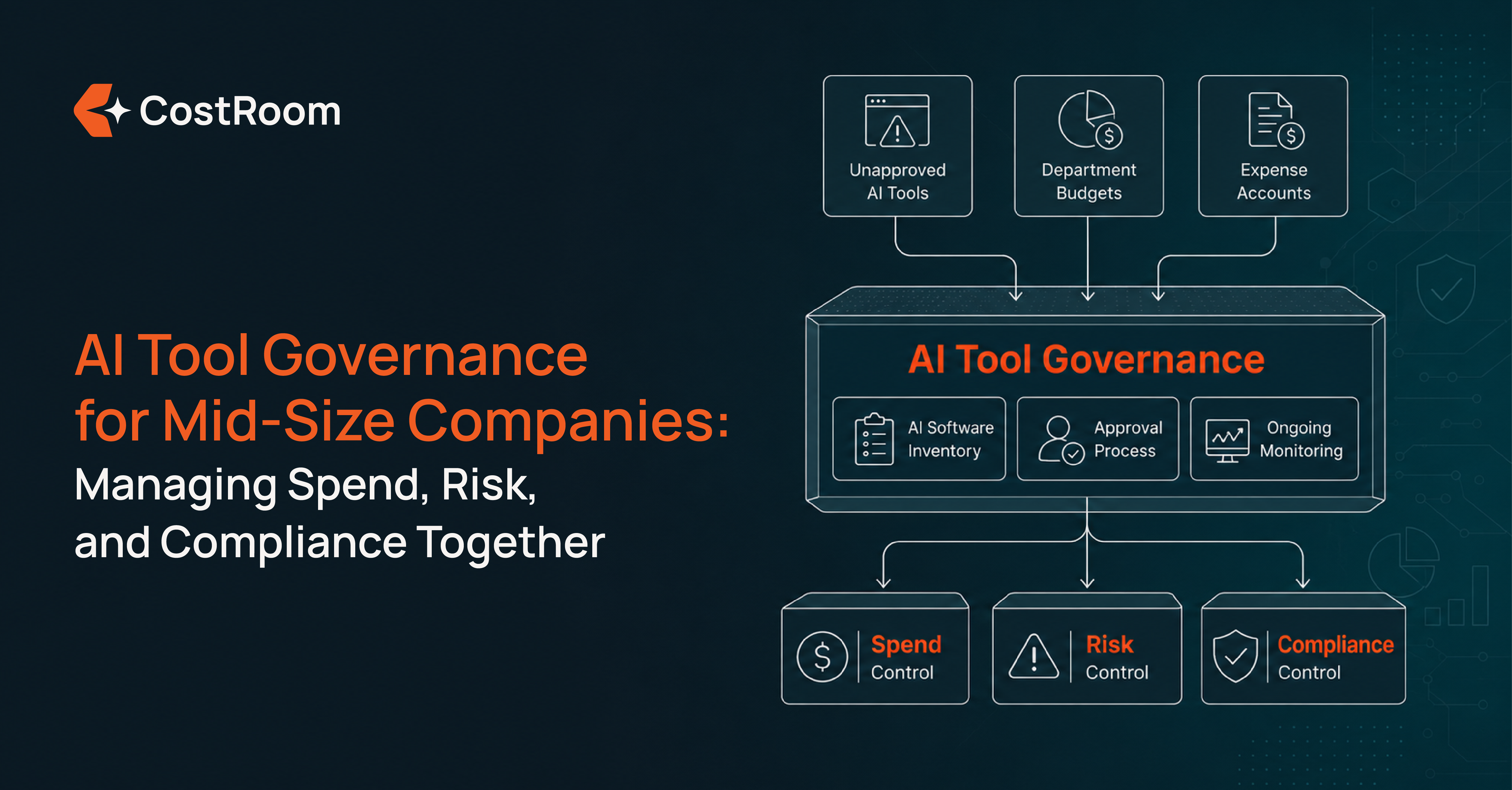
AI tool governance is the set of policies, processes, and controls a company uses to manage which AI tools are in use, who approved them, what data they access, and whether they meet the company's compliance obligations. It is specifically about the operational control of AI software as a spend, risk, and compliance category.
That definition separates AI tool governance from two things it is often confused with. It is not enterprise AI ethics, which is a board-level concern about algorithmic fairness and societal impact. And it is not general IT security governance, which covers the full technology estate. AI tool governance sits in the middle: it is practical, operational, and directly connected to cost control and regulatory compliance in a way that most mid-size companies have not yet addressed.
The practical scope covers three questions. First, visibility: what AI tools are active in the organisation, who is using them, and what is being spent? Second, assessment: have those tools been reviewed for data handling, security posture, and contractual compliance? Third, control: is there a process that applies before any new AI tool is deployed, and a monitoring mechanism that runs after deployment?
Most mid-size companies can answer the first question partially. Almost none have a structured answer to the second or third.
Why AI Tool Governance Has Become Urgent in 2026
Three pressures have converged to make AI tool governance a practical operational priority rather than a theoretical best practice.
The first is the scale of ungoverned AI usage. According to UpGuard's 2025 State of Unsanctioned AI Tools Report, 81% of workers now use AI tools their organisation has not approved. IBM's research found that only 37% of organisations have any policy in place to manage or detect unsanctioned AI tool usage. These are not edge cases: they describe the majority of mid-size companies operating in the current environment.
The second is that the governance gap is most acute at mid-market scale. Grant Thornton's 2026 research found that 19% of mid-market companies have no formal AI governance approach at all, compared to 8% at enterprise level. Mid-size companies are adopting AI tools at enterprise pace while carrying less than half the governance infrastructure. The gap between adoption rate and governance maturity is widening, not closing.
The third is regulatory change. The EU AI Act now applies to SMEs using high-risk AI systems, a category that includes many HR, financial, and healthcare AI tools already in common use. GDPR enforcement continues to intensify. Gartner estimates $492 million in AI governance spending in 2026 and projects that AI regulation will cover 75% of global economies by 2030. The regulatory environment is moving toward mid-size companies, not away from them.
The Three AI Tool Categories Mid-Size Companies Need to Govern
Understanding the governance challenge starts with understanding what is actually in the portfolio. Most mid-size AI tool estates contain three distinct categories, and governance requirements differ significantly across them.
Approved tools are AI tools that went through a formal procurement or review process. A data processing agreement was signed, a security assessment was completed, the tool was integrated into the IT estate, and someone is accountable for its renewal. At most mid-size companies, this category represents a minority of the total AI tools in active use.
Tolerated tools are AI tools that are actively used across the company and known to IT or finance, but were never formally reviewed or contracted. The tool may have started as a trial that no one cancelled, or been purchased by a department below the approval threshold. It appears on an invoice somewhere. No one has reviewed its data handling terms or assessed its security posture.
Unknown tools represent the majority of the AI usage problem. These are tools being used by employees, often for entirely legitimate work purposes, that have never appeared in any procurement, IT, or finance system. They enter through expense accounts, personal credit cards, or free tiers that convert to paid plans when usage crosses a threshold. Flexera's 2026 State of ITAM Report found that only 31% of organisations have accurate AI software visibility. The typical mid-size company does not know the scope of its own AI tool usage.
Governance without visibility is not possible. The sequence matters: inventory first, then policy and process.
What Ungoverned AI Tools Actually Cost
The cost of ungoverned AI tools operates at three layers, and each compounds the others.
The direct cost layer is AI spend that is not managed: tools purchased at list price through individual expense accounts with no benchmarking review and no contract; trials that converted to paid plans without anyone noticing; licences duplicated across teams because no central record exists of what is already in use. Flexera's 2026 data found that 59% of organisations say their wasted AI spend increased year-over-year. For a company spending $500,000 annually on AI tools across its portfolio, 59% of that portfolio showing increased waste represents a material unmanaged cost. For more on how AI tool spend accumulates outside managed budgets, see Why AI Tools Are Becoming Mid-Size Companies' Fastest-Growing Unmanaged Spend.
The compliance cost layer is the exposure created when AI tools process company data without a reviewed contract. IBM's 2025 Cost of a Data Breach Report found that incidents involving unsanctioned AI tools cost on average $670,000 more than standard data breaches. One in five organisations has already experienced a breach tied to unsanctioned AI tool usage. When an employee uses an AI tool for work without a formal contract, the company typically has no documented agreement covering how the vendor handles company data, no right to notification if the vendor is breached, and no contractual recourse. The compliance gap is not theoretical: it is a documented source of incremental breach cost.
The regulatory cost layer is the emerging financial exposure as AI-specific regulation takes effect. The EU AI Act imposes obligations on companies that use high-risk AI systems, including many HR screening, financial risk assessment, and healthcare diagnostic tools that mid-size companies are already deploying. GDPR requires that any processing of personal data by a third-party tool be covered by a data processing agreement; most unsanctioned AI tools do not have one in place. Fines and remediation costs for regulatory non-compliance accumulate independently of breach costs.
For the full picture of how these cost layers interact with vendor risk more broadly, see SaaS and Cloud Vendor Risk Management: The Complete Guide for Mid-Size Companies.
The Four Elements of an AI Tool Governance Framework
A practical AI tool governance framework for a mid-size company without a dedicated compliance function has four components. The sequence is intentional: each builds on the one before it.
1. AI Software Inventory
Governance starts with visibility. Without an accurate picture of every AI tool active in the organisation, including what it costs, who uses it, and what data it accesses, every subsequent governance effort is operating on incomplete information.
Building the AI software inventory requires reconciling three data sources: the finance or ERP system (tools on direct invoice), the IT system (tools with an organisational login assigned), and expense management (tools purchased by individuals or teams below the approval threshold). The gap between what appears in finance and what surfaces in expense management is where the unsanctioned AI tool population lives. For how this reconciliation works in practice for the broader SaaS and AI portfolio, see Why Mid-Size Companies Have More Uncontracted SaaS Spend Than They Think.
2. Acceptable Use Policy
The acceptable use policy defines what employees can and cannot do with AI tools at work. At minimum, it should cover: which AI tools are approved for use; what data categories cannot be input into any AI tool without prior review (personally identifiable information, financial data, client data, source code); what the process is for requesting approval of a new AI tool; and what happens if an employee discovers they have been using a tool that has not been approved.
A one-page acceptable use policy is achievable and sufficient for most mid-size companies. IBM's research found that only 37% of organisations have any such policy. Having one puts a company in the better-governed minority and creates the operational foundation for everything that follows.
3. Approval and Review Process
The approval process is the intake mechanism that applies before any new AI tool is deployed. It does not need to be a full enterprise procurement process. The minimum effective review for a new AI tool covers four questions: What data will this tool access? Where is that data stored and processed? Does the vendor hold current security certifications? Does the contract include a data processing agreement and an exit clause?
For most tools in the tolerated or low-risk category, this review can be completed in two to three days. For high-risk tools, a fuller assessment is warranted. The goal is a documented review record for every AI tool in active use, so that if a vendor is breached or a regulator asks, the company can demonstrate it conducted due diligence. For how this review process connects to the broader vendor risk assessment framework, see What Is a SaaS Vendor Risk Assessment and How Does It Work?.
4. Ongoing Monitoring
AI tools change: their capabilities expand, their data handling terms are updated, their ownership changes through acquisition. An approval granted eighteen months ago may no longer accurately reflect what the tool does or what the vendor's obligations are.
Ongoing monitoring means reviewing the AI tool inventory periodically, flagging tools where vendor terms have changed materially since the last review, and reassessing tools that have expanded their data access since initial approval. Aligning this review cycle to the annual renewal calendar is the most efficient approach: the renewal point is when the company has the most leverage to demand updated terms, and it is also the natural point to confirm that a tool's current usage still reflects what was originally approved.
Where Mid-Size Companies Get Stuck on AI Governance
Most mid-size companies that have attempted to govern their AI tool portfolio encounter one of three failure modes.
The first is applying enterprise frameworks at mid-market scale. NIST AI RMF, ISO 42001, and similar frameworks are comprehensive and rigorous, and they were built for organisations with dedicated risk management functions, legal teams, and compliance officers. A mid-size IT Director trying to implement NIST AI RMF alongside existing operational responsibilities will either fail to complete the framework or produce a version so abbreviated that it provides no real protection.
The second is writing a policy without creating an enforcement mechanism. An acceptable use policy that employees have not been trained on, that has no detection capability attached to it, and that has never been referenced in any conversation about a specific AI tool is a document, not a governance framework. The policy needs a process attached to it.
The third is treating governance as a project with a completion date rather than an ongoing operational practice. The AI tool landscape is changing faster than most governance frameworks can track. A framework built in 2024 that has not been reviewed since is operating against a completely different set of tools, risks, and regulations than those that exist today.
The practical path through all three failure modes starts with the same step: build the inventory first. Visibility alone immediately surfaces the highest-risk items for prioritisation, and it gives the policy and process components something concrete to operate against.
AI Tool Governance vs. AI Spend Management: Why You Need Both
These are related but distinct disciplines, and conflating them produces a governance framework with structural gaps.
AI spend management addresses cost. It covers identifying what is being spent on AI tools across the portfolio, benchmarking that spend against market rates, right-sizing licences to current usage, managing renewal dates, and eliminating duplicate or unused tools. The goal is a portfolio where the company pays the right price for the right tools at the right time. For the comprehensive view of how AI spend management works across SaaS, cloud, and AI together, see Managing AI, SaaS, and Cloud Spend Together: A Guide for Mid-Size Companies.
AI tool governance addresses compliance and risk. It covers which tools are approved, what data they can access, whether they meet the company's regulatory obligations, how new tools are reviewed before deployment, and how the company responds if a vendor is breached or an audit is triggered. The goal is a portfolio where every active AI tool has been reviewed and carries documented approval.
A company that has spend management without governance is optimising costs on tools that are simultaneously creating compliance liability. A company that has governance without spend management is protecting itself from regulatory risk while overpaying for the tools it has approved. The two frameworks answer different questions and need to run alongside each other.
The Regulatory Dimension Mid-Size Companies Are Underestimating
The regulatory environment around AI tool usage has changed materially in 2026 and will continue to tighten.
EU AI Act. The EU AI Act classifies AI systems by risk level. High-risk systems, which include AI tools used in HR decisions, credit assessment, medical diagnosis support, and critical infrastructure management, carry specific obligations for companies that deploy them: conformity assessments, transparency requirements, and human oversight mechanisms. The Act now applies to SMEs operating within the EU or processing EU citizen data. Mid-size companies using AI tools in HR, finance, or healthcare processes need to assess whether those tools fall into high-risk categories under the Act.
GDPR. Any AI tool that processes personal data requires a data processing agreement covering how the data is stored, retained, and deleted. Most unsanctioned AI tools do not have a reviewed DPA in place. Every employee who inputs client names, employee data, or personally identifiable information into an unapproved AI tool is potentially creating a GDPR exposure for the company.
Sector-specific frameworks. HIPAA applies to any AI tool that processes protected health information. PCI DSS applies to tools that access or store payment card data. Companies in regulated industries that have deployed AI tools without a compliance review are carrying sector-specific exposure on top of general regulatory risk.
The trajectory. Gartner projects that AI regulation will cover 75% of global economies by 2030, up from a fraction of that today. The direction of travel is toward more regulation, higher penalties, and broader jurisdictional reach. Mid-size companies that build governance frameworks now are building ahead of regulatory requirements rather than scrambling to catch up.
Find Out What AI Tools Are Running in Your Organisation
CostRoom maps every active AI, SaaS, and cloud tool across your portfolio, identifies what is running without a reviewed contract, and delivers a prioritised action plan for spend and compliance.
How to Build an AI Governance Framework Without a Dedicated Team
A defensible AI governance baseline for a mid-size company is achievable in 8 to 12 weeks without a dedicated compliance officer. The work breaks into three phases.
Phase 1: Visibility (Weeks 1 to 3). Build the complete AI software inventory by reconciling finance, IT, and expense management data. The output is a full list of every active AI tool, categorised by risk tier (critical, standard, low-risk) and flagged for whether a formal contract and data processing agreement exist. This phase surfaces the highest-risk items immediately: tools in the critical tier with no contract on record are the priority for Phase 2.
Phase 2: Policy (Weeks 4 to 6). Draft and communicate a one-page acceptable use policy. Define which tools are approved, what data categories cannot be shared with any AI tool without prior review, and what the request process is for new tools. Communicate the policy to all employees with a brief explanation of why it exists and what they need to do differently. At this stage, training is more effective than enforcement.
Phase 3: Process (Weeks 7 to 12). Build the lightweight approval intake for new AI tools and begin working through the contract remediation list from Phase 1. The approval intake does not need to be lengthy: a structured five-question review covering data access, security posture, contractual terms, cost, and intended use is sufficient for most tools. The remediation list should be worked in tier order; critical tools first, standard tools at their next renewal point.
The result of these three phases is a documented AI governance baseline: an inventory, a policy, a process, and a remediation record. For how the approval and review process works in detail, see How to Build an AI Tool Approval and Review Process Without a Dedicated IT Team.
CostRoom's Spend Analysis and Optimisation covers the visibility and spend management layers as an integrated engagement: every active AI tool mapped, spend benchmarked, and a prioritised list of where to act on both cost and compliance dimensions simultaneously.
See What a Governed AI Portfolio Looks Like
CostRoom delivers the AI software inventory, spend benchmarking, and contract compliance review that forms the foundation of a practical AI governance framework for mid-size companies.
Frequently Asked Questions
What is AI tool governance?
AI tool governance is the set of policies, processes, and controls a company uses to manage which AI tools are in use, who approved them, what data they access, and whether they meet the company's compliance obligations. It covers three operational questions: what AI tools are active in the organisation, have those tools been reviewed for data handling and security, and is there a process that applies before any new AI tool is deployed?
Why do mid-size companies need an AI governance framework?
81% of workers now use AI tools their organisation has not approved, according to UpGuard's 2025 research. Only 37% of organisations have any policy to manage or detect unsanctioned AI usage, per IBM. Grant Thornton's 2026 data found that 19% of mid-market companies have no formal AI governance approach at all. At the same time, the EU AI Act now applies to SMEs, GDPR enforcement is intensifying, and IBM found that incidents involving unsanctioned AI tools cost an average of $670,000 more than standard data breaches.
What is the difference between AI governance and AI spend management?
AI spend management addresses cost: what is being spent on AI tools, whether pricing is at market rate, which licences are unused or duplicated, and when contracts renew. AI tool governance addresses compliance and risk: which tools are approved, what data they access, whether they meet regulatory obligations, and how new tools are reviewed before deployment. The two frameworks answer different questions and need to run together. Spend management without governance optimises costs on tools that may be creating compliance liability. Governance without spend management is compliant but overpaying.
What regulations apply to AI tool usage at mid-size companies in 2026?
The EU AI Act applies to SMEs using high-risk AI systems, which includes many HR, financial, and healthcare AI tools in common use. GDPR requires a data processing agreement for any AI tool that processes personal data. Sector-specific frameworks apply in regulated industries: HIPAA for health data, PCI DSS for payment data. Gartner projects that AI regulation will cover 75% of global economies by 2030. The regulatory trend is toward greater coverage and higher penalties.
How do you build an AI governance framework without a dedicated compliance team?
A defensible baseline is achievable in 8 to 12 weeks in three phases. Phase 1 (weeks 1 to 3): build the complete AI software inventory by reconciling finance, IT, and expense management data. Phase 2 (weeks 4 to 6): draft and communicate a one-page acceptable use policy. Phase 3 (weeks 7 to 12): build the approval intake process for new tools and work through the contract remediation list from Phase 1 in risk-tier order. The result is an inventory, a policy, a process, and a documented remediation record: a governance baseline that does not require a dedicated compliance officer to maintain.